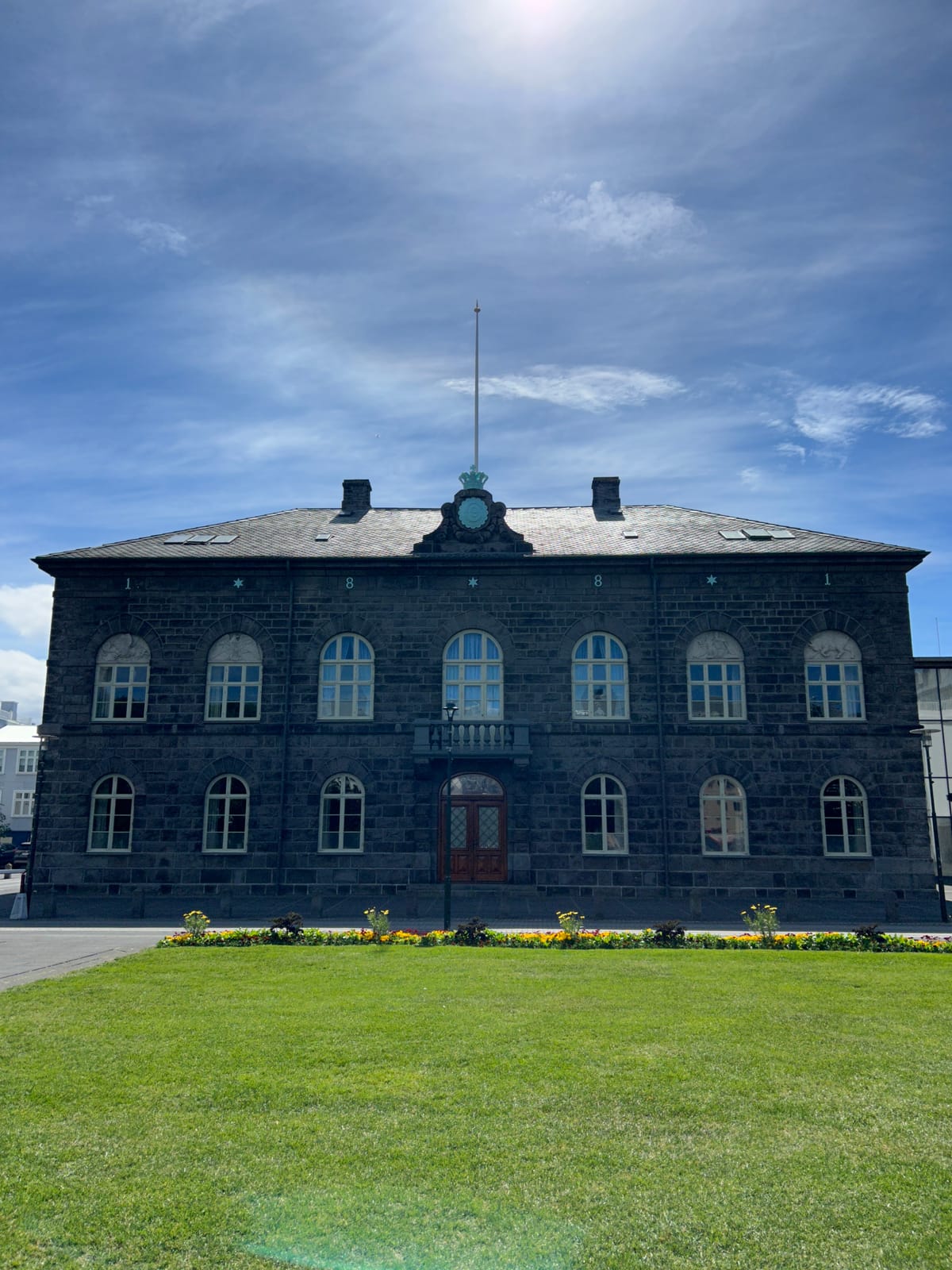
On Austurvöllur, one of the small green squares in the middle of Reykjavík, there is a plain grey stone building two storeys high that you could easily walk past for a bank or an old school. People sit on the grass in front of it in summer, the cathedral stands next door, and there is very little to tell you that this modest house is where the country makes its laws.
The surprise is in the gap between the building and the thing it holds. The parliament inside, the Alþingi, was first gathered in the year 930 at Þingvellir, out in the rift valley to the east, which makes it one of the oldest parliaments anywhere in the world. The house itself is much younger. It was raised in 1880 and 1881 to a design by the Danish architect Ferdinand Meldahl, cut from Icelandic dolerite, so the idea inside is a thousand years older than the walls around it.
Look up before you move on. Above four of the upper windows the stone carries the four guardian spirits of Iceland, the landvættir, a bull and a great bird and a dragon and a giant, the same four that hold up the country on its coat of arms. They are easy to miss and worth finding, four old protectors keeping a stone eye on the people passing laws below them.
The square in front carries its own weight. Austurvöllur is where the city comes together, to celebrate on the national day and to complain loudly when it needs to, and in the cold early months of 2009, after the banks fell, it filled with people banging pots and pans until the government stepped down. The lawn in front of the parliament is, in a real sense, a national living room.
You cannot wander inside without arrangement, but the building does not really ask you to. It rewards a slow look from the square, the stone, the spirits over the windows, the cathedral beside it, and the ordinary life of the city going on around something very old. It sits in the walkable centre of the old town, so it is easy to fold into a morning of wandering the nearby streets.
To send a photograph of this small grey house is to send a thousand years of an idea folded into one plain building. Add your own words to it for someone who values that kind of long patience, and the picture becomes a note as much as a postcard.