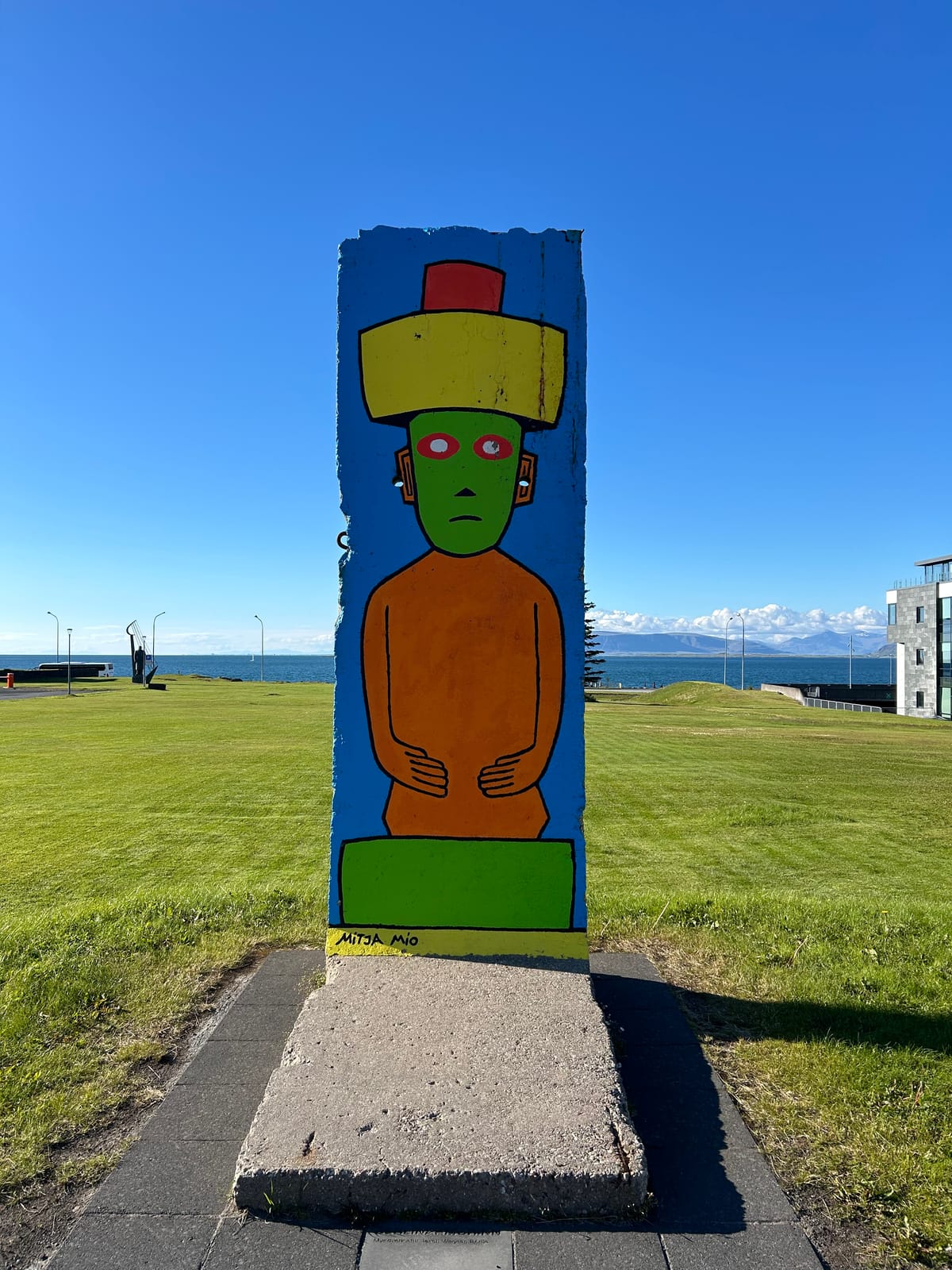
On the grass near Höfði, a single concrete slab stands upright with a bright cartoon figure painted across it, green face, yellow hat, round astonished eyes. It looks cheerful from a distance and stranger the closer you get, because the slab is not a copy of anything. It is a piece of the Berlin Wall, the real thing, standing on a lawn in Reykjavík three and a half metres tall.
The Wall went up through the middle of Berlin overnight in August 1961 and stood for twenty eight years, a hundred and fifty five kilometres of concrete, wire and watchtowers wrapped around the western half of the city. At least a hundred and forty people died trying to cross it. It was the plainest object the Cold War ever produced: a wall built by a state to keep its own people in.
The reason a piece of it stands here, and not in any other small capital, is the white house behind it. In October 1986 Ronald Reagan and Mikhail Gorbachev met at Höfði for a summit that was scored as a failure at the time, because the two men walked away without a deal. What they did not walk away from was the talking. The thaw that started in that house carried on, the treaties followed, and three years later, in November 1989, the Wall opened and then came down. Icelanders like to say the end of the Cold War began at Höfði. The slab on the lawn is Berlin agreeing.
It arrived on the third of October 2015, the Day of German Unity, twenty five years after the two Germanys became one again, a gift to the city from the Neu West Berlin gallery. It came painted in the bright cartoon manner that Thierry Noir, a Frenchman living beside the Wall, began in 1984, when painting on it was still an act of nerve.
The paint carries the whole story, if you read it slowly. In Berlin only one face of the Wall ever carried colour, the western one, because only on that side could a person walk up to it holding a brush. The eastern face answered to a death strip. A painted wall sounds like a decorated one until you remember that the decoration marks the side where people were free to stand.
The slab shares its corner of the shore with good company: Höfði itself, the poet Einar Benediktsson, and Sigurjón Ólafsson’s Öndvegissúlur a little way along the grass. It is a strange, strong cluster, a Cold War summit and a piece of the wall the summit helped bring down, all within one stretch of lawn on the Sæbraut walk.
There is no fence and no fee, and the slab is at its best in low sun, when the paint burns against the grey concrete. Sign a photograph of it for someone who has just broken through a wall of their own, a border, a habit, a fear, and the card carries the best news the twentieth century ever produced: walls fall.