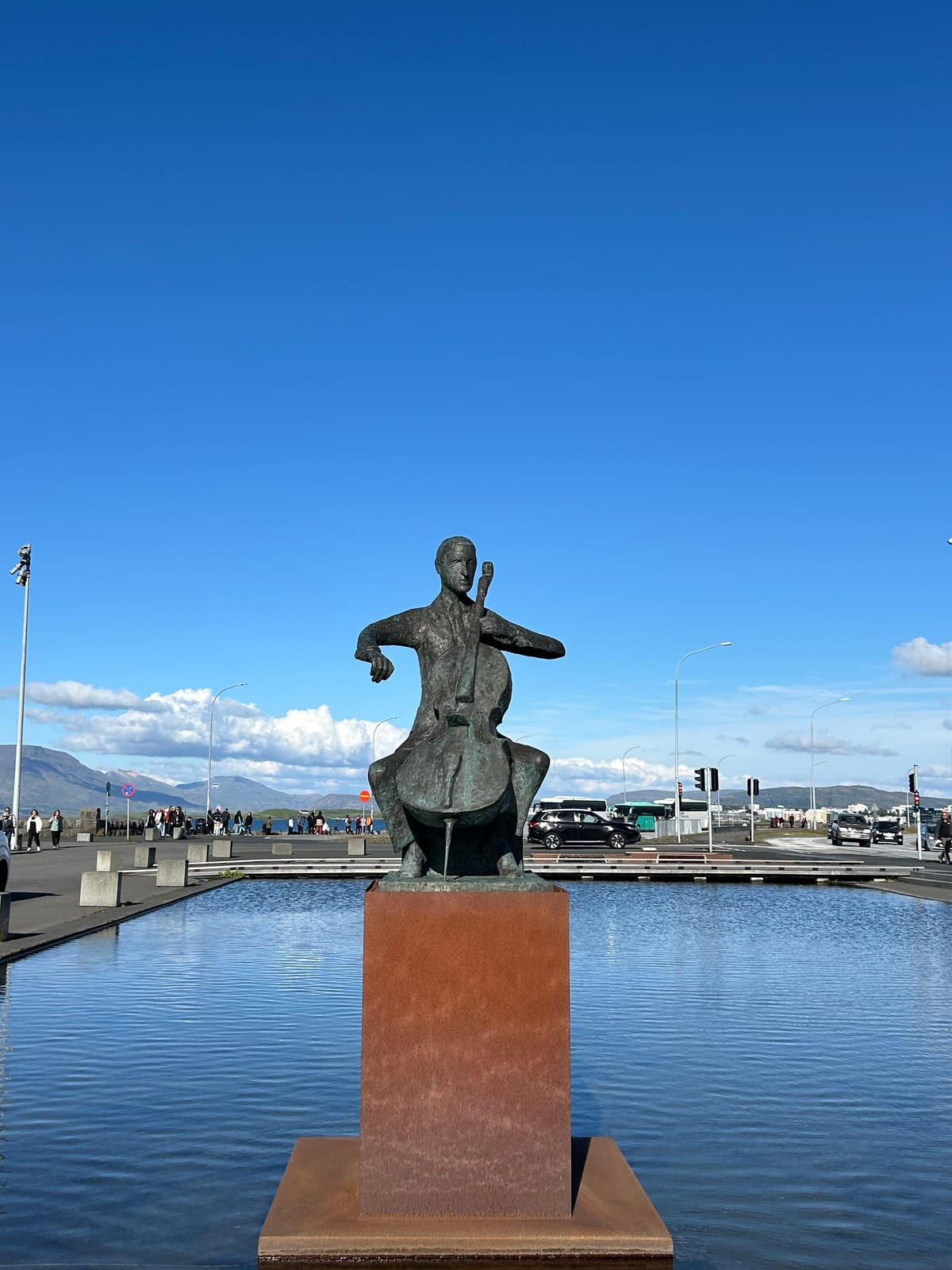
In the shallow water on the harbour side of Harpa, a bronze man in evening dress sits on a rust red plinth with a cello between his knees, bow raised, head tilted, caught in the middle of a phrase. The pose is so exact that you can almost name the note. Then you step closer and notice the one thing missing. The cello has no strings, and it never has had.
The work is called Tónlistarmaðurinn, the Musician, and it was made in 1970 by Ólöf Pálsdóttir, one of the leading Icelandic sculptors of the last century. She modelled it on a real man, the cellist Erling Blöndal Bengtsson, and the sittings were unlike any other she had. Erling did not sit. He played, for hours, piece after piece, while she worked, and she said afterwards that she never enjoyed making anything as much, because not every model can give that much of himself while holding a pose.
Erling was born in Copenhagen in 1932 to an Icelandic mother and a Danish father, and both countries have claimed him ever since. He was a prodigy who was performing in public as a small child and went on to one of the great cello careers of the north, six decades of concerts and a long life of teaching, in Copenhagen and later in America, where generations of cellists passed through his studio. Iceland gave him its highest honours and kept his mother’s share of him firmly on the books.
The statue has followed the country’s concert life around town. It was first raised in 1977 at Hagatorg, outside Háskólabíó, the cinema that doubled for decades as the symphony orchestra’s home. When the orchestra finally moved into Harpa, the Musician eventually followed, and in September 2014 he was set down in the water by the new hall. Erling had died the year before, so he never saw himself bowing at the harbour, which gives the spot a shade of memorial it was not born with.
The missing strings turn out to be the point. Ólöf made everything else true to life, the coat, the hands, the instrument, and left out the one part that makes the sound, so the music stays where it has to stay, in the person looking. Stand in front of him for a minute and your memory supplies a cello better than any speaker could.
He is also one half of a pair. On the other side of the building, on the city side square, stands Himinglæva, the steel wave strung like a harp that the wind actually plays. Harpa keeps two instruments outdoors: one that makes real sound from moving air, and one that makes imagined sound from nothing at all. Between them the glass hall does its own trick with the light.
The water, the rust red plinth and the mountain across the bay make this one of the easiest photographs on the harbour walk, two minutes from the old pier and thirty seconds from Harpa’s doors. Sign it for the musician in your life, or for someone whose talent you can hear even when they are not in the room, and the card says exactly that: I do not need the strings to hear you.