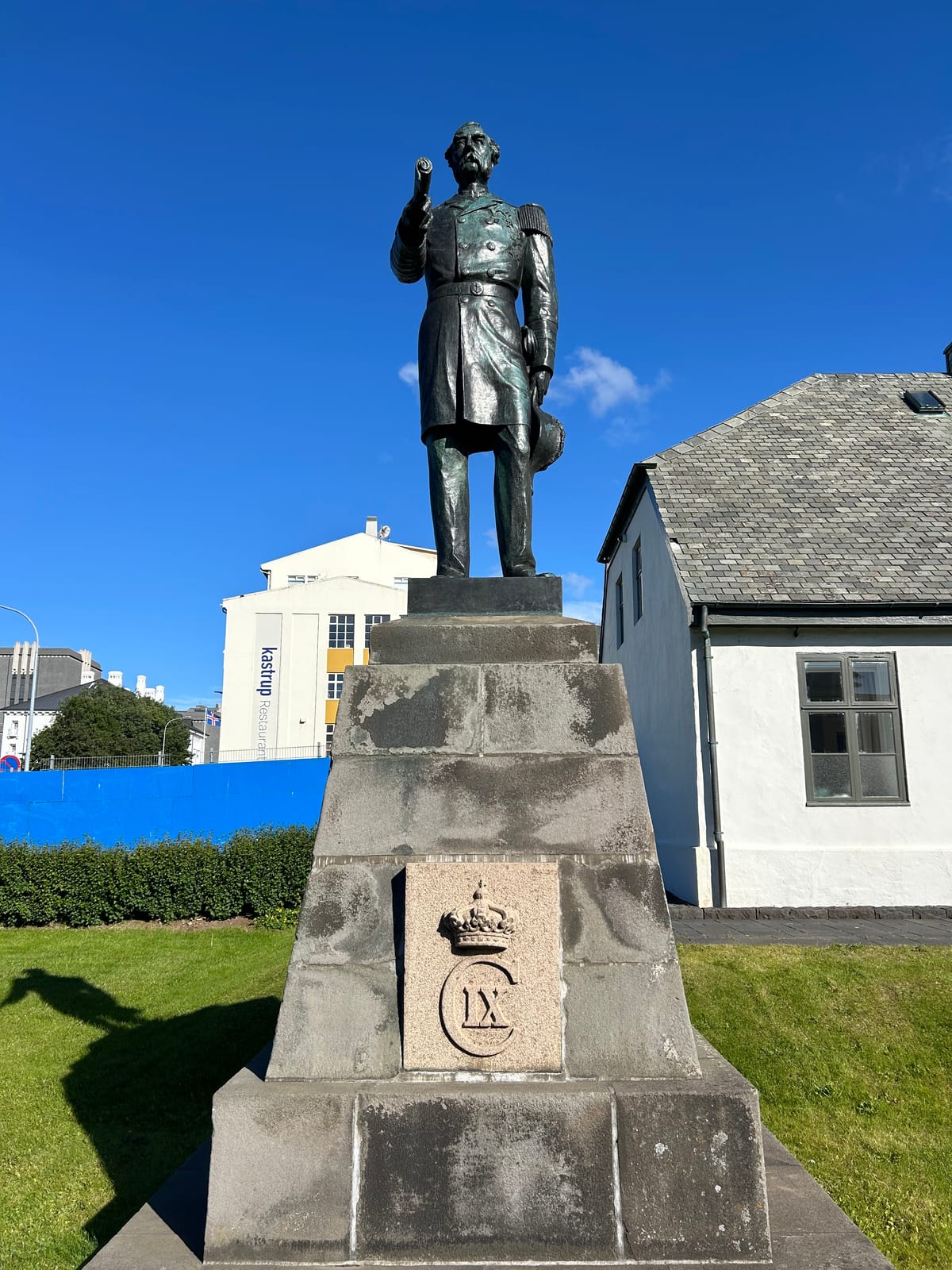
On the lawn in front of Government House, where Lækjargata runs past the white building at the foot of Arnarhóll, a bronze king stands on a tall stone plinth with one arm held out toward the street, a document in the outstretched hand. He is not waving and he is not pointing. He is handing something over. The king is Christian IX of Denmark, the document in his hand is a constitution, and the gesture has been frozen in the middle of the gift for more than a century.
The year to know is 1874. Iceland was marking a thousand years since the first settlers arrived, and Christian sailed north to join the festival, the first reigning monarch ever to set foot on the island. He did not come empty handed. He brought the constitution of 1874, the country’s first written frame of government, which gave the Alþingi real power over Icelandic law and money for the first time in centuries.
It was a gift with conditions, as royal gifts tend to be. The king kept his veto, the executive stayed answerable to Copenhagen, and Icelanders spent the next seventy years politely and stubbornly asking for the rest. Home rule came in 1904, sovereignty in 1918, and the republic in 1944, declared at Þingvellir on a June day of pouring rain. The bronze on the lawn holds the first step of that story, not the last one.
Christian himself is one of history’s unlikely dynasts. A minor German princeling by birth, he began his reign in 1863 and within a year had lost a war and a third of his kingdom. Then his children married, and kept marrying, until Europe called him its father-in-law. One daughter became queen of Britain, another empress of Russia, one son king of the Greeks. The man offering Iceland its constitution had grandchildren on half the thrones of Europe.
The statue is the work of Einar Jónsson, the first professional sculptor Iceland produced, the same hands that set Ingólfur Arnarson on his hill above the harbour and filled the walled garden below Hallgrímskirkja with angels and riders. It was unveiled in 1915 on the lawn of what was by then the seat of the Icelandic government, and the pose reads in a single second: here, this is yours now.
He does not stand alone. On the far corner of the same lawn, with his back to the same house, stands Hannes Hafstein, the first Icelander ever to govern Iceland as its minister. Between them sits the low stone building raised as a prison in the 1760s and promoted, over a century and a half, into the office of the prime minister. One corner holds the king who handed the constitution over, the other holds the man who first put it to work, and forty metres of grass carry the whole constitutional history of a country.
The lawn is open, free and a minute from Arnarhóll, the harbour and Austurvöllur, so the king folds easily into any walk through the old centre. Sign a photograph of him for someone who has just been trusted with something large, a team, a project, a set of keys, and the card says what the bronze has been saying since 1915: it is yours now, look after it.