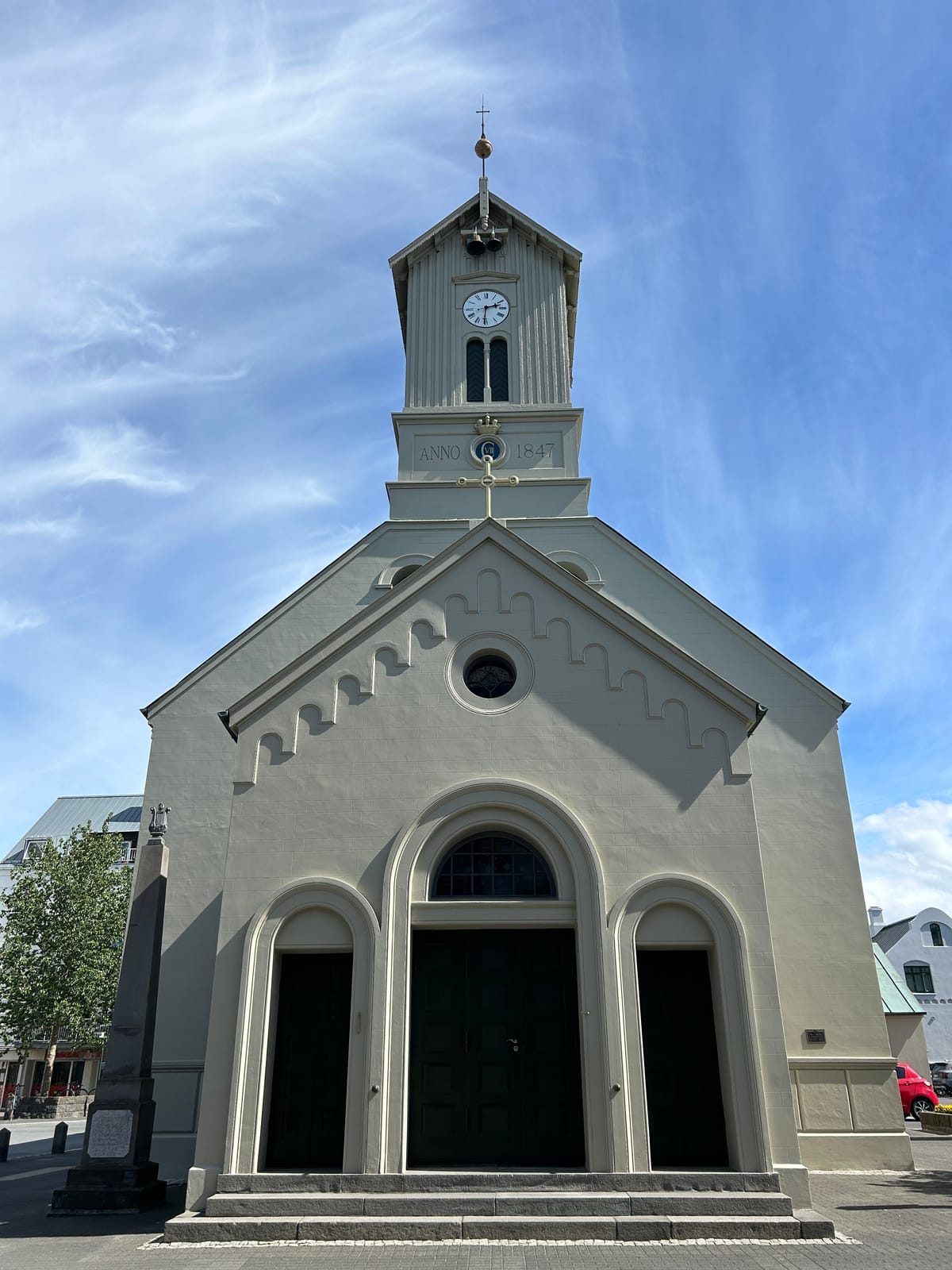
On Austurvöllur, the green square in the middle of old Reykjavík, there is a small church that most visitors walk straight past. It is pale and plain, two low storeys under a modest tower, and it sits a little in the shadow of the parliament beside it and a long way in the shadow of Hallgrímskirkja up on the hill. Yet this plain building, and not the great concrete tower, is the cathedral of Reykjavík.
The church was built between 1787 and 1796 to a neoclassical design by the Danish architect Andreas Kirkerup, and it carries a claim the bigger churches cannot. It was the first building in the town raised in the knowledge that Reykjavík was going to become a capital. When it was consecrated in 1796 the place around it was barely more than a scatter of houses, and the cathedral was already built for a country that did not quite exist yet.
It did not stay as it began. In 1847 and 1848 it was enlarged and raised again, this time to a design by the Danish architect Laurits Winstrup, and that is more or less the building you see today. Inside, the thing worth crossing the floor for is the baptismal font, a piece of white Italian marble carved by Bertel Thorvaldsen, the celebrated sculptor of Danish and Icelandic parentage who spent most of his life working in Rome. It is a surprising thing to find standing in so plain a room.
The real character of the place comes from one morning a year. Since the Alþingi, the Icelandic parliament, was brought back in 1845, every new session has opened with a service in this church. The members gather under its roof, the dean of the cathedral leads the prayers, and then the whole parliament walks the short distance from the cathedral door to the parliament house to begin its work. Church and state keep a polite distance through most of Icelandic life, and then once a year they walk out of the same door together.
That closeness is built into the ground as well as the calendar. The parliament house was raised right against the square not long after the parliament returned, so the cathedral and the Alþingi now stand almost shoulder to shoulder on Austurvöllur, both of them facing the same patch of grass where the city comes to celebrate on its national day and to bang pots and protest when it is angry.
Visiting is simple and free when no service is on. You step in off the square to a plain, pale interior with a gallery running around it and the Thorvaldsen font near the door, and after the height and drama of Hallgrímskirkja it feels almost domestic in here. The cathedral sits in the walkable old town, next to the parliament and a minute from the pond, so it folds easily into a slow morning of wandering the centre.
There is something very Icelandic about a place whose most photographed church is the landmark on the hill, while its actual cathedral is this modest house on the square, the one the lawmakers keep coming back to. Sign a photograph of it for someone who trusts the steady, understated things over the loud ones, and the card carries a little of that same restraint.