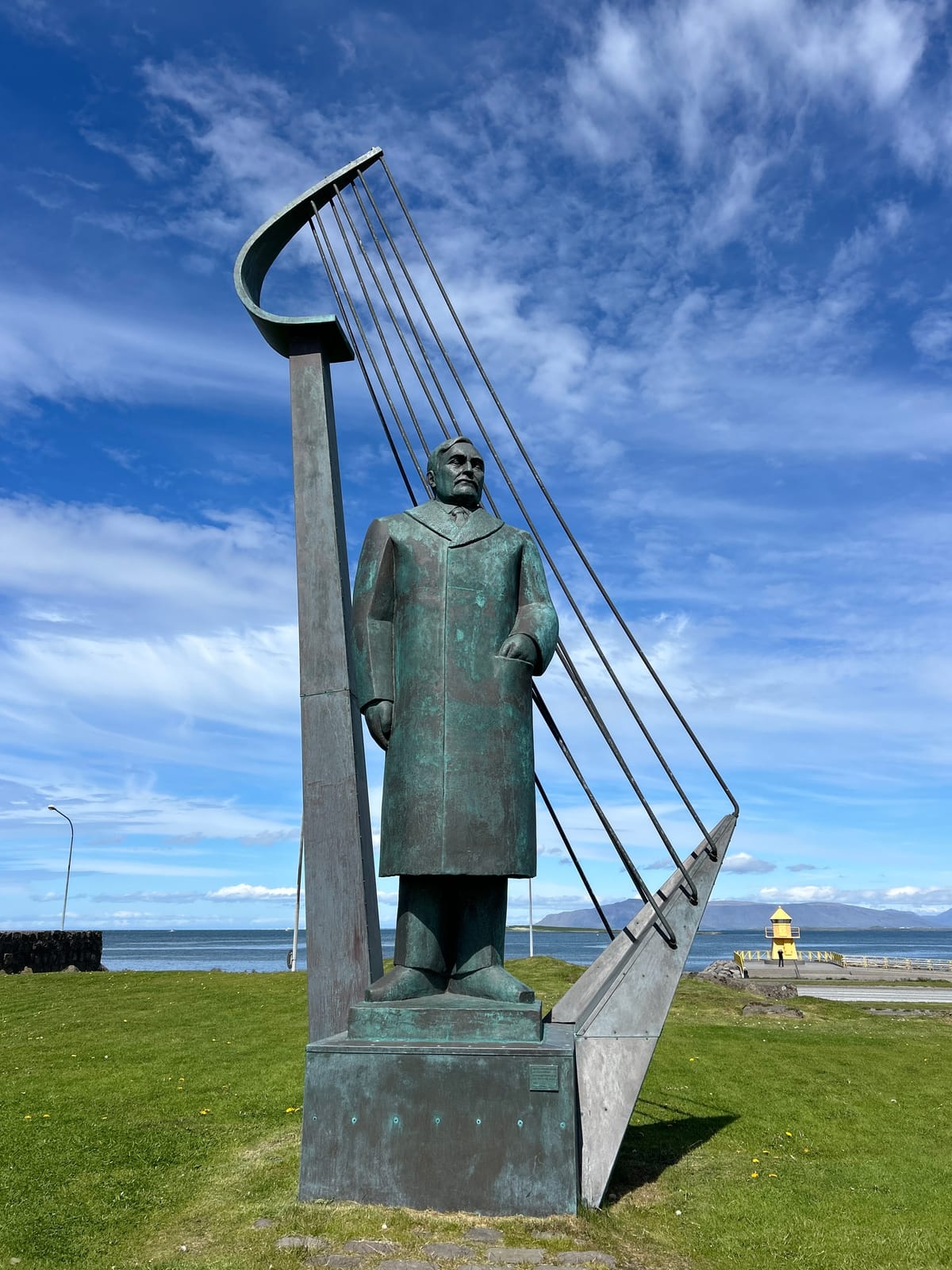
On the north shore of Reykjavík, on the grass beside the white house called Höfði, a tall bronze man in a long coat stands with a harp at his side, his back to the bay. He has the bearing of someone in the middle of a thought he considers important, and the harp beside him is the first sign that this was no ordinary public figure. It belongs to Einar Benediktsson, who was a poet, and also a great deal more than that.
Einar lived from 1864 to 1940 and is counted among the finest of the Icelandic neo romantic poets, a writer of long, grand, heavily worked verse about nature and the spirit and the future of his small country. He trained as a lawyer, he argued for Iceland to break free of Danish rule long before it happened, and in 1896 he founded Dagskrá, the first daily newspaper the country had ever had. For a nation of a few tens of thousands of people scattered around a cold island, a man like this was a sizeable portion of its public life all by himself.
What makes him stranger and more memorable than most poets is the other half of his life. Einar was an entrepreneur of enormous and largely unrealised ambition. He spent years abroad chasing foreign money to harness Iceland’s waterfalls for electricity and to dig its minerals out of the ground, and the schemes mostly came to nothing, which did not slow him down at all. The story that has outlived all of them is that he once tried to sell the northern lights to foreign investors. Whether it happened quite like that hardly matters now, because it is exactly the sort of legend that attaches itself to a man who genuinely seemed to believe the sky over Iceland was an asset waiting for the right buyer.
The statue is the work of Ásmundur Sveinsson, one of the great Icelandic sculptors of the last century, who finished it in 1964. He gave Einar the harp on purpose. Ásmundur wanted to show that the man had been great in everything he turned his hand to, the poetry and the grand plans alike, and the harp stands in for all of that reach. It is a generous reading of a complicated life, and standing in front of it you can believe the sculptor meant it warmly.
For its first fifty years the statue stood inland, in the green park at Klambratún, and only in 2015 did the city move it down to the shore beside Höfði. The new spot is the right one. Einar lived in that white house for a dozen years early in the last century, long before it became the place where Reagan and Gorbachev sat down together in 1986, so the move brought the poet back to his own front garden. The man and the house now share one patch of grass by the water.
It takes only a few minutes to visit, and most people come for the house and find the poet by accident. Walk the shore path east from the Sun Voyager and the Partnership sculpture, and Höfði and its bronze resident sit together a little apart from everything, with Mount Esja across the bay behind them. Morning light suits the figure, when the coat and the harp still hold a little of the cold off the sea.
There is something fitting about sending a photograph of a man who dreamed far past anything his country could hold at the time. Sign one for someone with a head full of plans that everyone else thinks are too big, and the picture tells them that you are on their side.