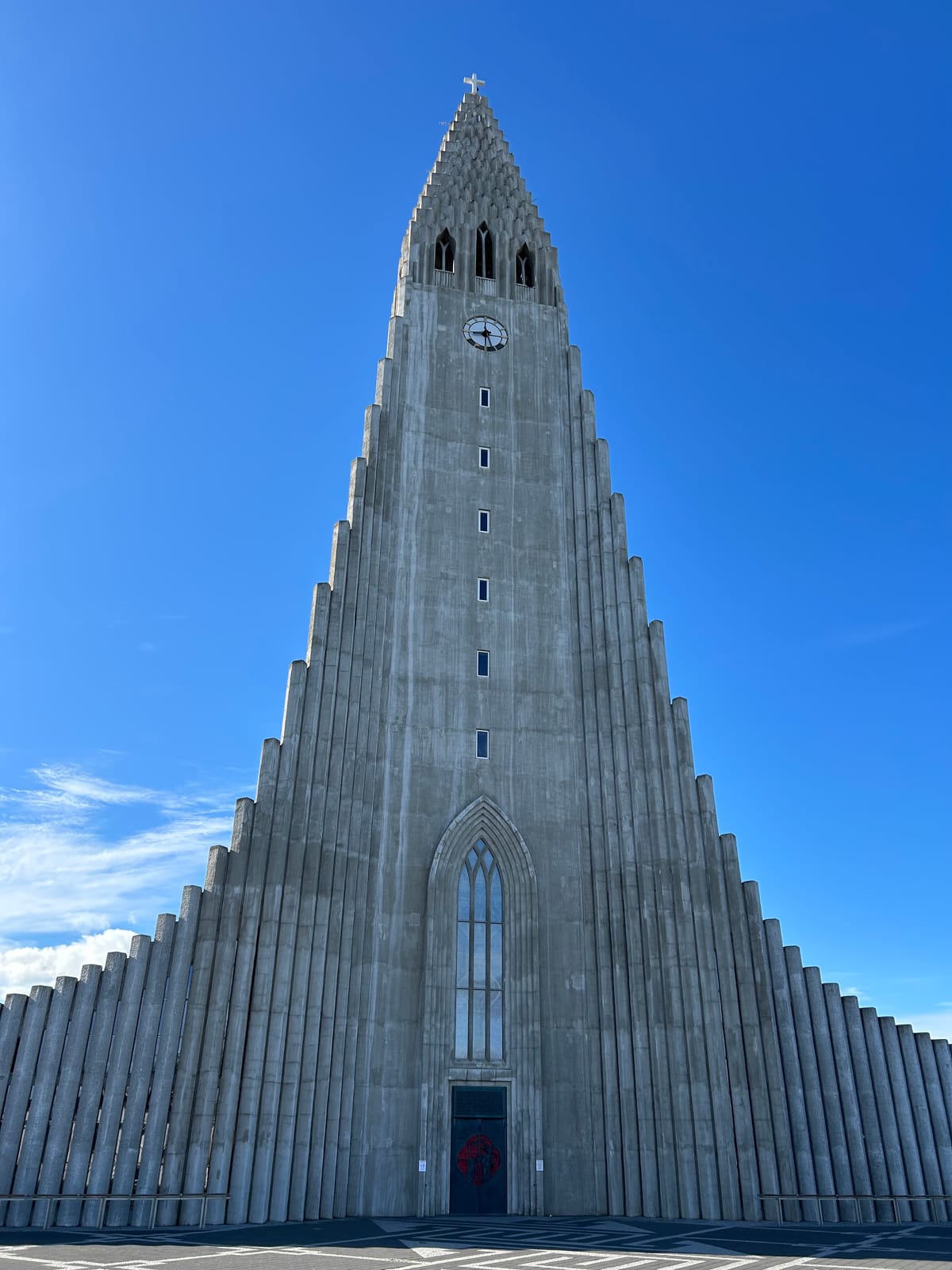
You can see it from almost anywhere in Reykjavík. The church stands on Skólavörðuholt, the low hill at the top of the old town, and its pale grey tower rises over the coloured roofs like something the city was built around rather than something added to it later. Walk up Skólavörðustígur toward it and the front opens out in front of you, two great wings of stepped concrete sweeping down from the tower to the ground, with a statue of Leif Erikson keeping watch on the slope below.
The shape is not an accident and it is not borrowed from anywhere else. The architect, Guðjón Samúelsson, looked at the basalt columns that form along the Icelandic coast, the tall hexagonal pillars you find at places like Reynisfjara and Svartifoss, and he built the front of the church to echo them. The result is a building that seems to have grown out of the same ground as the cliffs, which is a rare thing for a church to manage. It reads as Icelandic before it reads as anything religious.
It was also built with enormous patience. The design dates to the late nineteen thirties, the first concrete was poured in 1945, and the church was not finished until 1986, more than forty years later. Guðjón did not live to see it rise to any real height, since he died in 1950, so the tower he drew was raised by other hands over the decades that followed. A whole generation of people in Reykjavík grew up watching it slowly become itself.
The name belongs to a writer rather than a king or a bishop. Hallgrímur Pétursson was a seventeenth century poet and clergyman, best known for a long cycle of hymns on the passion of Christ that Icelanders have carried with them for centuries. There is something telling about a nation giving its largest church the name of a poet. Words have always mattered here, and the building is, among other things, a monument to a man who was good with them.
Most people go up the tower, and they are right to. A lift takes you most of the way and a short set of steps does the rest, and at the top the whole city is laid out beneath you, the red and blue and green roofs, the bay, and Mount Esja on the far side. The inside is the opposite of the view, plain and tall and full of pale light, with a great organ at the back and very little decoration to pull your attention around. Early morning is the best time, before the tour groups arrive.
To send a photograph of Hallgrímskirkja is to send a small piece of the city that everyone in it can see from their own window. Add a few of your own words to it and it stops being a postcard of a landmark and becomes something closer to a note from a particular person who stood on that hill on a particular day. That is the difference we are after.