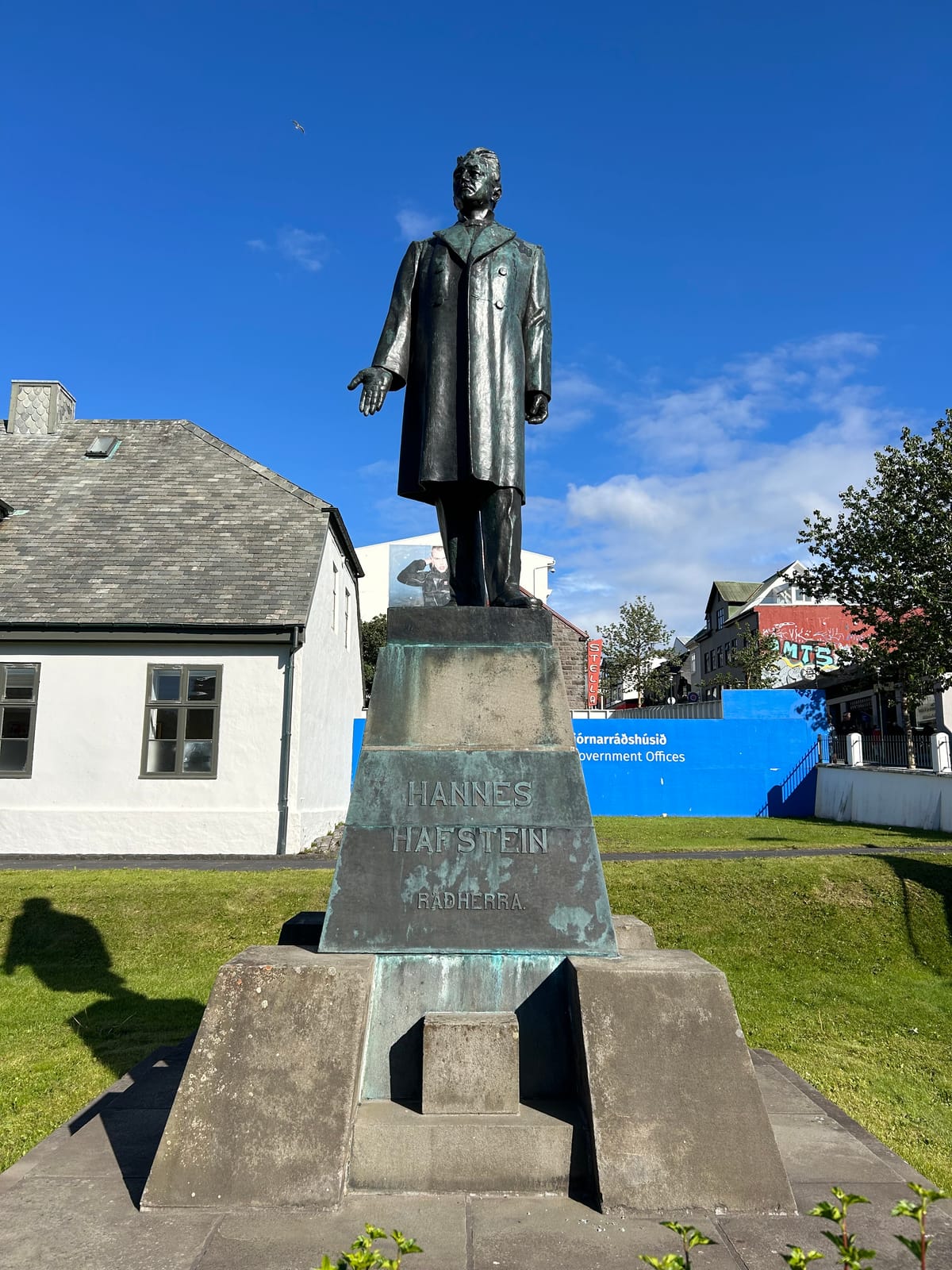
On the other corner of the Government House lawn, a tall bronze man in a long coat stands with one hand open at his side, palm forward, as if he had just finished making a point and was waiting to see whether it landed. The plinth under him carries a name, Hannes Hafstein, and one title, ráðherra, minister. In 1904 he walked into the white building behind him as the first Icelander ever to govern Iceland.
For most of its history the country had been run from Copenhagen, often by men who had never seen it. Home rule changed that in 1904. Iceland got a single minister of its own, answerable to the Alþingi rather than to a Danish official, working from Reykjavík, and Hannes was the man chosen. The entire government of Iceland fitted at the time into a few rooms of the former prison at his back, which is why the statue stands exactly here. This is not a monument placed near a landmark. It is a man outside his own office.
He was an unlikely shape for a founding statesman, because Icelanders knew him first as a poet. His verses were the confident, weather-beaten kind, full of storms ridden out and roads pushed through, and schoolchildren were reciting them long before anyone called him minister. The poems and the politics were the same optimism in two different forms.
There was iron under the verse. In 1899, as a young sheriff in the Westfjords, he rowed out into Dýrafjörður with a small crew to arrest the captain of a British trawler fishing illegally inside the fjord. The trawler ran their boat down. Three of his men drowned, and Hannes barely reached the shore alive. The ship sailed away. Five years later the survivor of that fjord was running the country.
What he pushed through in office reads like a century of catching up compressed into five years. The telegraph cable that tied Iceland to the outside world in 1906, and the telephone lines that followed it. Roads, bridges, schools, a college for training teachers, the first serious money for forestry. His opponents fought the telegraph as a waste of a poor country’s money. He built it anyway, and within a generation nobody could imagine the island without a wire to the world.
The statue is by Einar Jónsson, who by then had already given the city its Ingólfur and its king, and it was unveiled in 1931 on the minister’s own lawn. Across the grass, on the opposite corner, Christian IX of Denmark holds out the constitution he brought over in 1874. The pair make one plain argument between them: a king handed the tools over, and an Icelander picked them up. Both face the street rather than the house, which feels right. The work was always out there, not in the corridors.
The lawn is open day and night, free, a minute from Arnarhóll and two from the harbour, and hardly anyone who photographs the white house notices the two bronzes bracketing it. Sign a photograph of Hannes for someone stepping into a job that feels a size too big, a first team, a first company, a first day at the head of the table. The card carries the example of a poet who was handed a country and got to work.