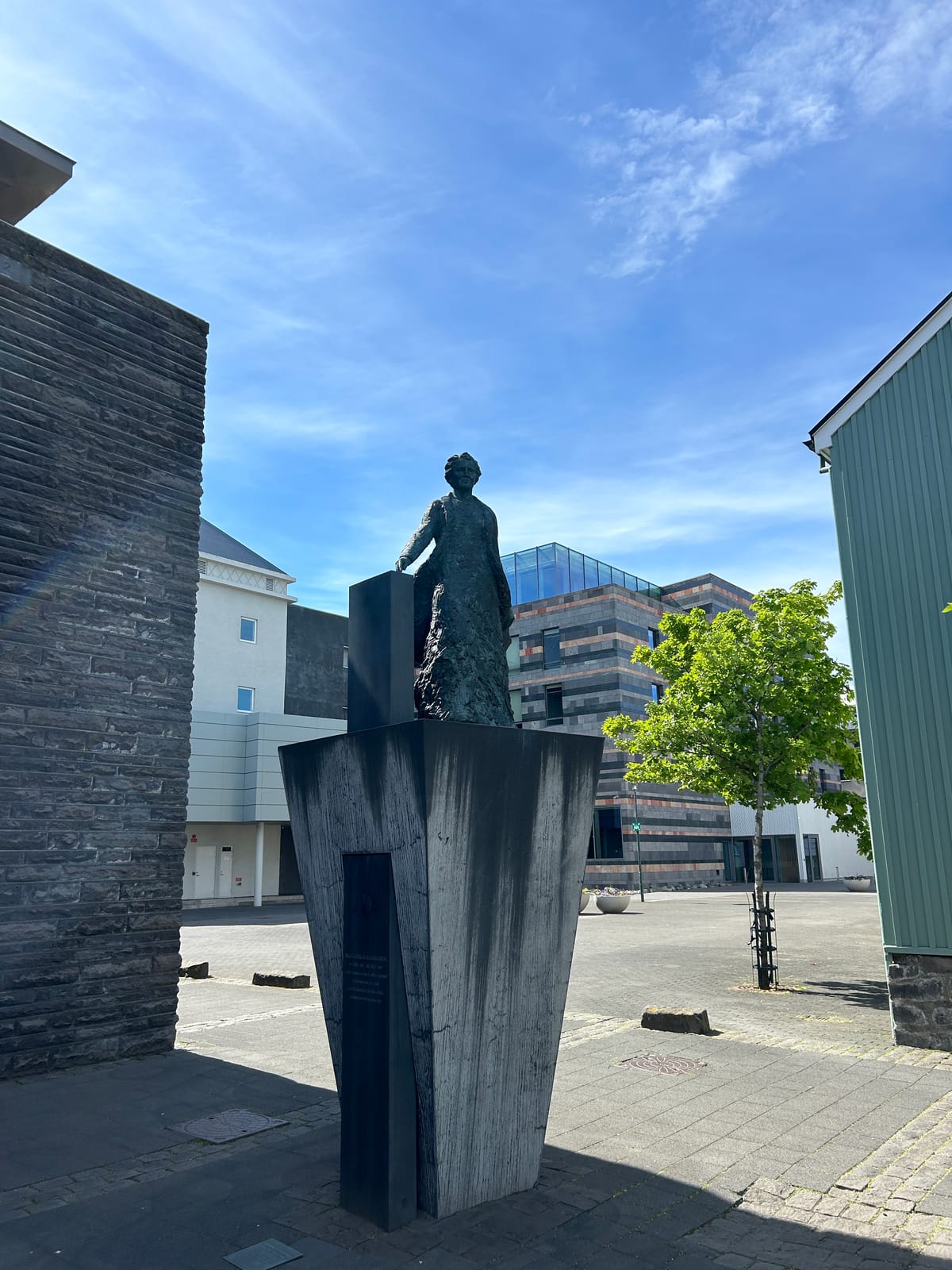
Beside the parliament house, on a dark angular plinth that looks like a door forced open, stands a woman in a long dress with her hair pinned up, one hand a little raised, entirely unbothered. She looks out across Austurvöllur, toward Jón Sigurðsson on his column. Ingibjörg H. Bjarnason spent years getting through that particular door, and the statue keeps its place beside it now.
She was a teacher before she was anything else. Born in 1867, she trained in Copenhagen, came home, and in 1906 became headmistress of the Women’s College in Reykjavík, the school that educated generations of Icelandic women, and she ran it for the rest of her life. Whatever else she took on, she kept the school. The politics grew out of the classroom, not the other way round.
The vote came first. On the nineteenth of June 1915 Icelandic women won the right to vote in national elections, among the earliest in the world, and Ingibjörg stood at the front of the movement that carried it. Seven years later, in 1922, she went one further: elected to the Alþingi from a dedicated women’s list, the first woman ever to sit in Iceland’s parliament, in a chamber of men who had strong opinions about her being there.
Her great parliamentary cause had begun as the suffrage movement’s own project: Landspítali, the national hospital, which the women of Iceland proposed as their monument to the vote, a memorial made of wards and beds rather than bronze. Ingibjörg pushed the hospital through committee after committee until it opened in 1930. It is a rare kind of politician whose chief monument admits patients around the clock.
The statue is by Ragnhildur Stefánsdóttir and it was unveiled on the nineteenth of June 2015, one hundred years to the day after the vote was won. It carries a distinction that says as much about the city as about her: this was the first full statue of a named woman ever raised in Reykjavík. The men of the independence era got theirs within decades. The first woman in parliament waited ninety three years, and the sculptor set her, fittingly, one step from the door.
She stands in the thick of the civic cluster now: the parliament at her right shoulder, Jón Sigurðsson on his column across the grass, the cathedral, the Black Cone and the square between them. Every member of the Alþingi, and every schoolgirl on a class trip, walks past her on the way in.
Sign a photograph of her for someone going first, the first in the family to study, the first woman in the room, the first through any door that was not built for them, and the card carries what the statue states without a word: the door is open now, walk in like you own it.