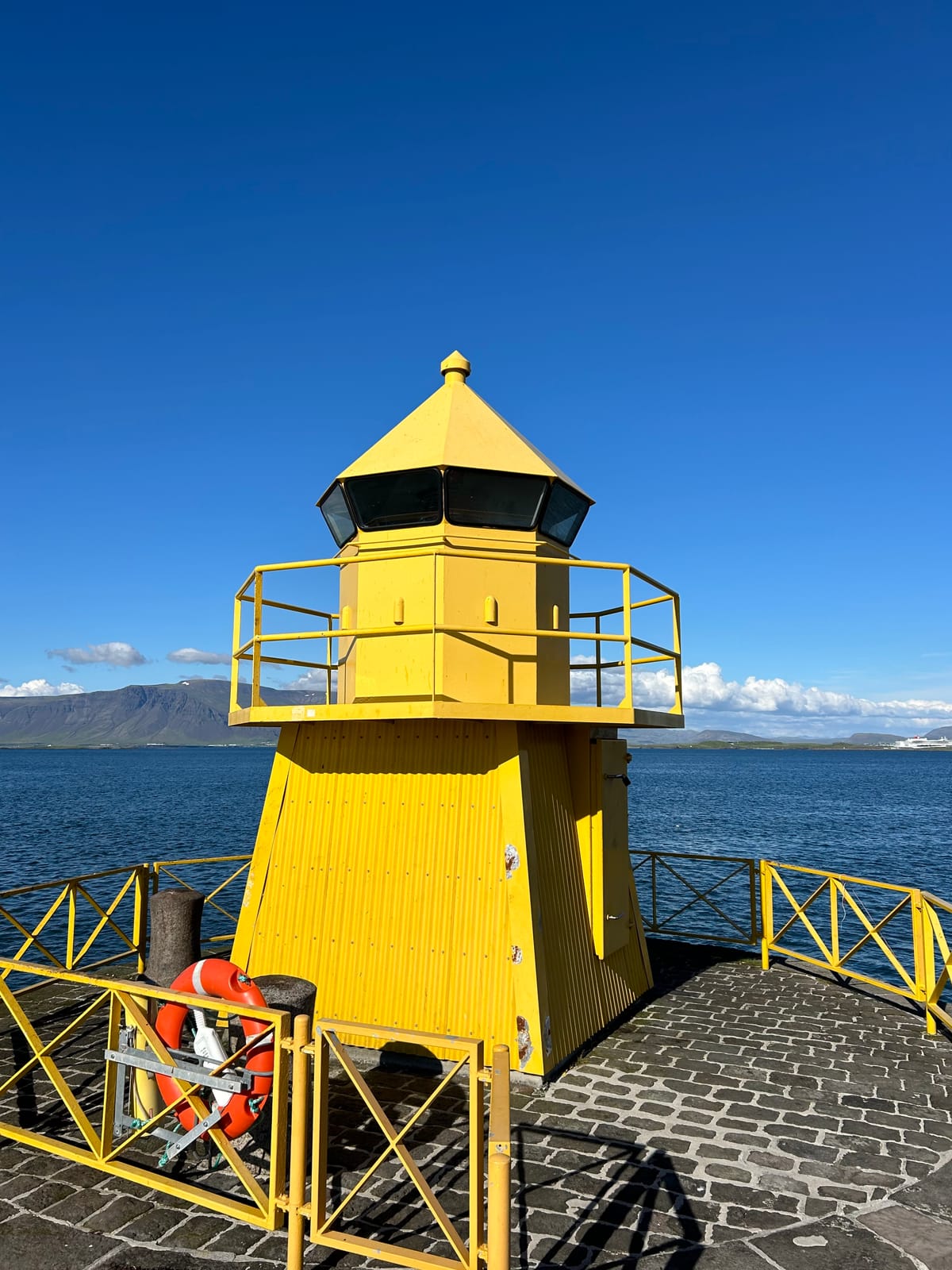
Reykjavík’s old harbour has two long stone arms that reach out into the bay and almost meet, leaving a narrow gap for the boats to pass through, and on the end of the longer arm there is a small, bright yellow lighthouse. It is a cheerful, almost toy like thing against all that grey water and moving sky, square shouldered under a little pointed cap, and you can walk straight out to it along the breakwater from the middle of the city.
The arm it stands on is called Ingólfsgarður, after Ingólfur Arnarson, the settler the sagas place at the very beginning of Reykjavík. The light marks the mouth of the harbour, the working gap that everything has to pass through, the whale watching boats and the small fishing vessels and, through the summer, the big cruise ships that dwarf the whole scene as they ease their way in and out.
There was no real harbour here for most of the city’s life. For centuries the boats simply had to be hauled up onto the beach, and it was only between 1913 and 1917 that Reykjavík finally built itself a proper one, throwing these two breakwaters out into the bay to make a patch of sheltered water behind them. It changed the town entirely. A fishing nation that had nowhere safe to land its catch suddenly had a working port, and much of the modern city grew out from around it.
Walking out to the light is one of the small pleasures of the harbour. The breakwater is paved in pale stone, the water slaps at both sides of it, and as you go the city slides out behind you and arranges itself along the shore, with the glass concert hall Harpa on the waterfront and the long flat wall of Mount Esja across the bay. Out at the far end there is not much more than you, the yellow tower, the gulls and the wind, which is rarely in short supply here.
The harbour it guards is still a working one, not a museum piece. Fishing boats land here, the whale watching fleet runs out from the same quays, and the old warehouses along the Grandi side have filled up with places to eat and a handful of small museums, so the walk out to the lighthouse pairs easily with a slow afternoon by the water. It costs nothing and asks only that you dress for the weather, because the end of a breakwater in Reykjavík is an honest place to feel the Atlantic arrive.
Come in the low evening light, when the yellow of the tower warms right up against the cooling sky and the boats are coming back in. That is the harbour at its best, and the little light at the end of the arm is the thing your eye keeps returning to.
A lighthouse at the mouth of a harbour is about as clear a thing as you can send to someone, a small bright marker standing exactly where the way in is. Sign a photograph of this one for a person who is coming home, or one you wish were closer, and the card carries the old and simple meaning of a light at the harbour mouth.