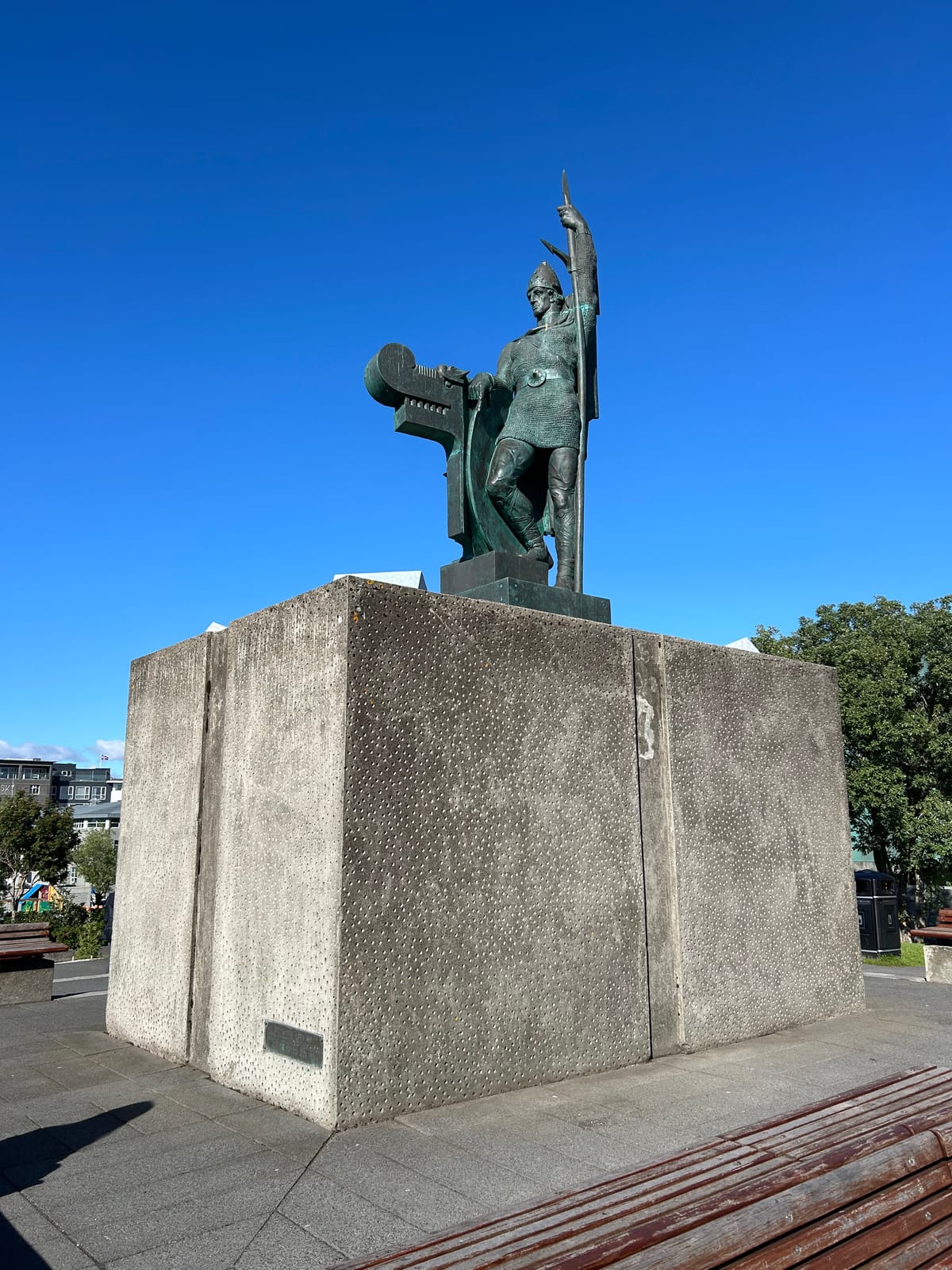
In the middle of central Reykjavík, between the concert hall and the parliament, the ground tilts up briefly into a low green hill called Arnarhóll. At the top of it stands a tall bronze man in furs and armour, leaning on a spear and looking north across the bay. People sit on the grass around him with sandwiches and bottles of beer, and on a warm day in summer the slope fills up like a stadium.
The man is Ingólfur Arnarson, the figure the sagas place at the start of the whole Icelandic story. The Book of Settlements has him land here around the year 874, name the place Reykjavík, which means the bay of smokes, on account of the steam coming off the hot springs, and call it home. Whether the dates and the details are exactly right is one of those questions historians enjoy, and what is certainly true is that this is the spot the country chose to mark as its beginning.
The statue was made by Einar Jónsson, the first professional sculptor Iceland produced, and it went up on the hill in 1924. He has Ingólfur standing by his high seat pillar, the carved wooden pillar that, by the legend, the settler threw into the sea from his ship and then followed wherever it washed ashore. There is a small carved figure of Odin on the other side of the pillar, with the two ravens at his feet, which is a fair amount of mythology for one piece of bronze.
Most of the meaning is in the view rather than the man. From his pedestal you look straight out over the harbour and Harpa, across the bay to Esja, and on a clear afternoon the whole north of the city sits laid out in front of you. It is a generous gift to a city, an old story and a wide view in the same place, and you do not have to take the saga literally to feel it.
It is one of the easiest things in Reykjavík to walk to and one of the most often missed by people in a hurry. The hill is just behind the concert hall on the harbour, a minute or two from the main shopping streets, and there is no fee and no queue.
Sending the founder of a city to someone who is starting something is a small, slightly grand thing to do. Sign it with a steady word and the photograph carries more than it shows.