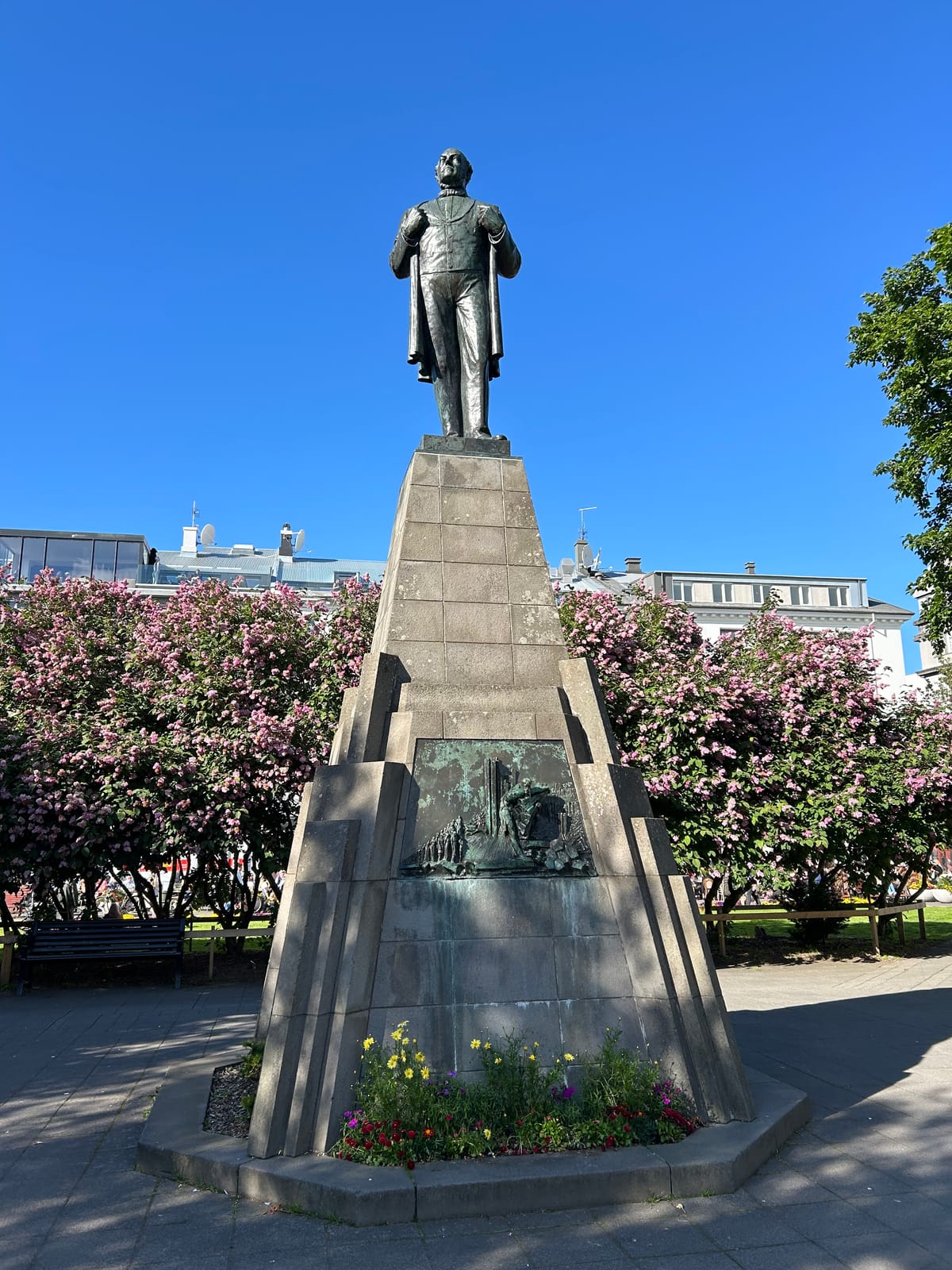
In the middle of Austurvöllur, on a tall stone column ringed with flowerbeds, a bronze man in a long coat stands with his face turned toward the parliament house, just a shade off square. The arrangement is not an accident. The parliament sits where he can watch it, and he stands where the members cannot avoid him. He is Jón Sigurðsson, and Iceland owes him more than it owes any other single person.
He was born in 1811 at Hrafnseyri in the Westfjords, went to Copenhagen to study, and spent the rest of his life there among the manuscripts, which turned out to be the most dangerous place an Icelander could possibly stand. Jón read everything the archives held about Iceland’s old rights, and then he did the simple, devastating thing: he argued, in print, calmly and endlessly, that Denmark’s hold on Iceland had no legal foundation. No army, no uprising, no shot fired. Footnotes.
His most famous moment lasted one sentence. At the national assembly of 1851 the Danish authorities moved to push through a constitution Iceland had not asked for, and when the royal representative dissolved the meeting, Jón stood and objected. The hall rose with him and answered in one voice: vér mótmælum allir, we all protest. It is the most quoted line in Icelandic political history, and it was, characteristically, a protest delivered in perfect parliamentary order.
Icelanders call him forseti, president, although he was never president of anything but learned societies and the restored Alþingi’s sessions. The republic he argued toward arrived in 1944, sixty five years after his death, and the founders chose its date with intent: the seventeenth of June, his birthday. Every national day since has been his birthday party.
The statue is by Einar Jónsson, unveiled in 1911 on the centenary of Jón’s birth, and it carries a second work hidden in plain sight: the bronze relief on the pedestal, Brautryðjandinn, the Pioneer, a figure forcing a path through standing basalt columns. The lifelike statue above was the commission. The relief below, Einar’s own gift, is what the sculptor actually thought of the man: someone who cleared stone so the rest could walk through.
The statue first stood by the Government House lawn and was moved here in 1931, to the square where everything happens. Protests gather at his feet, the pots and pans rang here in 2009 within sight of his column, brides from the cathedral cross the grass, and every session of parliament walks past him to work. He has the best seat in Icelandic public life.
Come on a bright morning when the flowerbeds are lit and the square is full, with the cathedral and the Black Cone a few steps away. Sign a photograph of him for the person who never raises their voice and wins anyway, the one who brings receipts instead of heat, and the card carries Jón’s whole method in one line: patience, evidence, and the nerve to keep saying it.