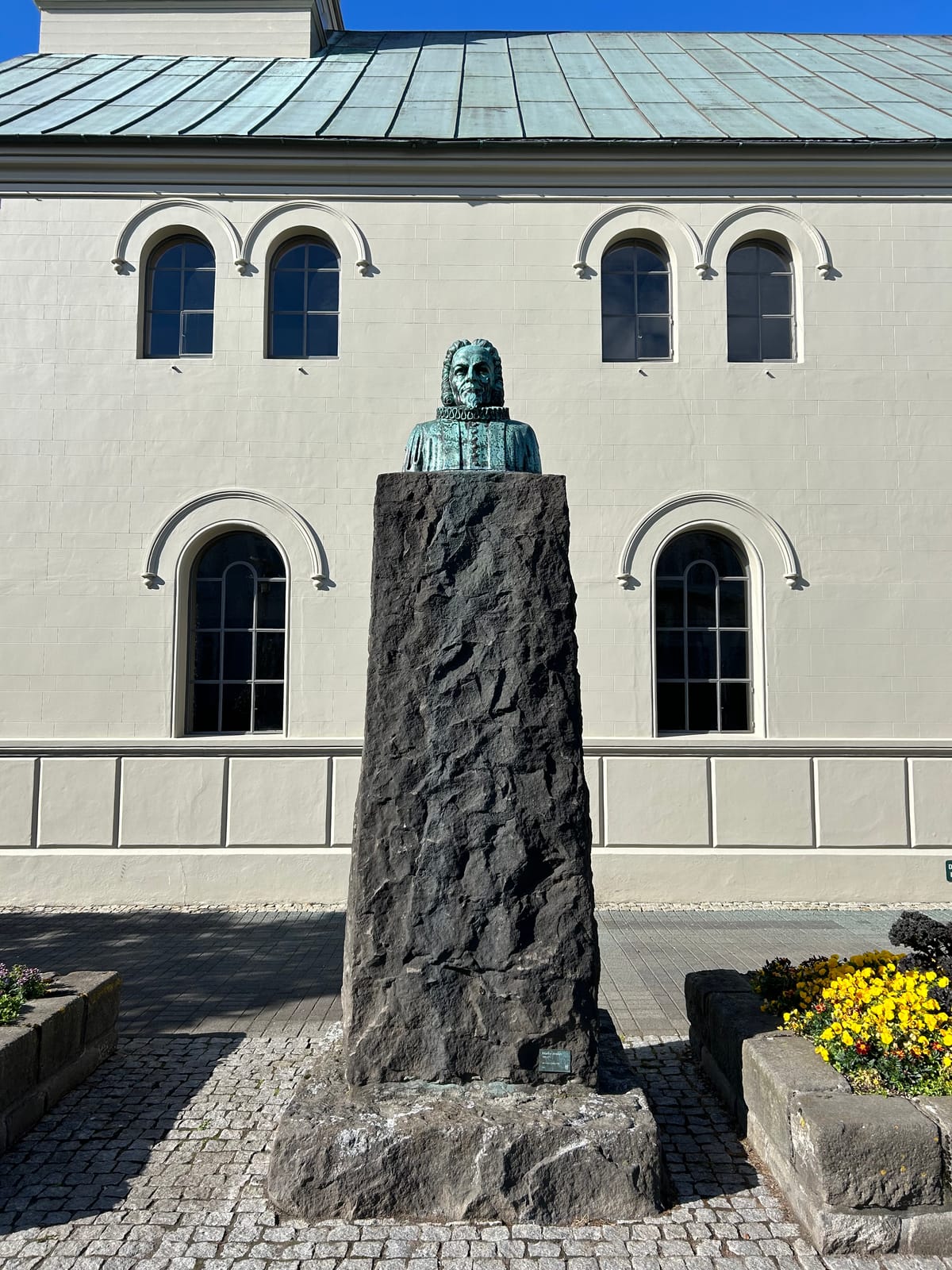
Beside the cathedral on Austurvöllur, a rough pillar of basalt carries a green bronze bust of a man in the great ruffed collar of a seventeenth century bishop. The collar is the first thing you notice and the face is the second, because it is not a meek church face. It belongs to Jón Vídalín, and for two hundred years his was the loudest voice in the Icelandic home.
Jón was born in 1666 into a family of scholars and got to his bishopric the long way round. He studied in Copenhagen, ran out of money, and spent a stretch as a soldier in the Danish army before Iceland pulled him back, first into the priesthood and then, in 1698, into the bishop’s seat at Skálholt, the most powerful church office in the south of the country. He was thirty two.
What made him immortal was a book. His collection of house sermons, known ever since simply as Vídalínspostilla, was printed in 1718 and became the book Icelandic families read aloud on Sunday evenings, generation after generation, on farms too far from any church. For two centuries it was the most read book in the country after the Bible itself, reprinted again and again, worn soft at the corners in a thousand turf houses.
The sermons deserved their run. Jón wrote like a man arguing for your soul rather than lecturing it, in short, hard, baroque sentences that thundered against pride and greed and comforted the poor, and Icelanders, who rank rhetoric somewhere alongside weatherproof walls, never forgot the sound of him. He preached the way the surf hits the south coast, and the farmhouses listened.
He died in harness. In the summer of 1720 he set out across the highlands to conduct a funeral in the north, fell ill on the way, and died at a spot on the old mountain road that has been called Biskupsbrekka, the bishop’s slope, ever since. Exactly two hundred years later, in 1920, Reykjavík raised this memorial beside its cathedral.
He does not stand alone at the church wall. A few steps away is a second bust, séra Bjarni Jónsson, the cathedral priest the whole town knew by sight, and between them the two bronzes bracket two very different kinds of churchman: the thunderer from Skálholt and the neighbour from up the street, two hundred years apart on the same wall.
The bust stands in the middle of everything, a step from the parliament, the square and the pond, and it costs nothing but a minute. Sign a photograph of it for someone whose words carry further than they think, a teacher, a writer, the friend whose voice you hear when you read their messages, and the card carries a fact worth repeating: the right words outlive their speaker by centuries.