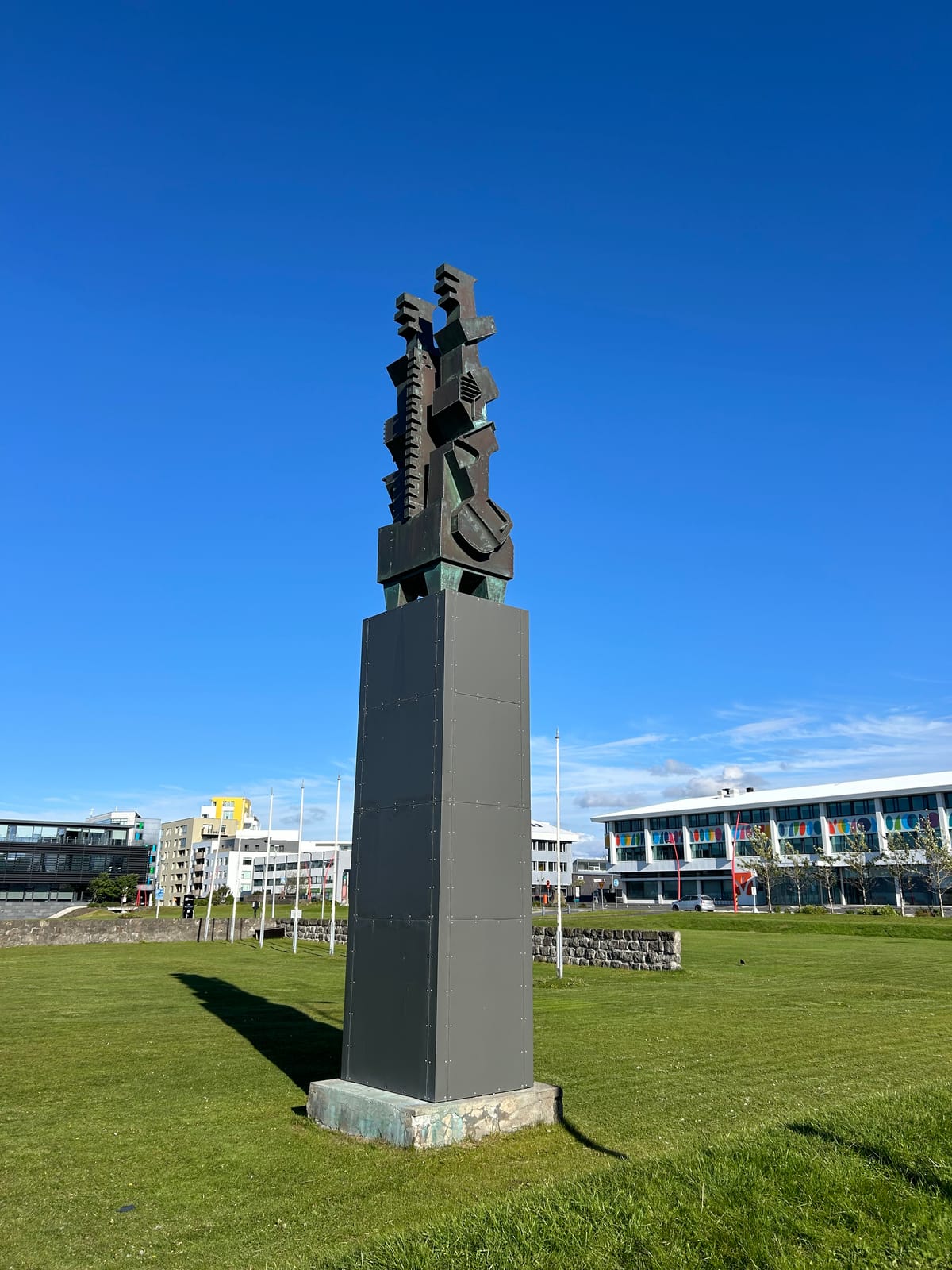
On the lawn beside Höfði, the white house on the Reykjavík shore, a tall dark pedestal lifts a sculpture of weathered copper high above the grass. Its angular forms, notched along their edges, are stacked upward into one standing shape. This is Öndvegissúlur, the work of Sigurjón Ólafsson, and it has stood beside the house since 1971.
Around 1970 the city of Reykjavík commissioned Sigurjón to make a sculpture for Höfði, the house the city uses for receptions and official guests, and he made it together with the blacksmith Gunnar Ferdinandsson. The work is not cast, as bronzes usually are. Its outside is cut copper sheet fixed over a sturdy iron frame, and the hollow inside was filled with concrete. In 1971 it was set up on its tall pedestal beside the house.
Sigurjón never gave the work a title. The name it carries came from the art historian Björn Th. Björnsson, who called it Öndvegissúlur, and Sigurjón’s widow asked that it be known by that name. Öndvegissúlur means high seat pillars, the carved posts that stood on either side of the seat of honour in a Norse hall.
The name makes it easy to take the sculpture for a monument to Ingólfur Arnarson, the settler whose high seat pillars are said to have washed ashore where Reykjavík began, but that is not what it is. The Reykjavík Art Museum, which holds the work in its collection, reads the name the plain way: the sculpture is one of Sigurjón’s variations on the pillar, a form that in his hands calls up both the ancient totem pole and the upright human figure. Ingólfur’s story has its own marker, the steaming Settlement Pillars on a square in the old centre.
Fifteen years after it went up, the sculpture found an audience that nobody could have planned for. In October 1986 Ronald Reagan and Mikhail Gorbachev met inside Höfði, at the summit now counted as an important step toward the end of the Cold War, and pictures of the white house went around the world with the sculpture standing on the lawn beside it. The museum reckons that it became perhaps more widely known than any other work by an Icelandic artist.
You will find it on the Höfði grounds, where the shore walk along Sæbraut reaches the white house, with the painted slab of the Berlin Wall and the poet Einar Benediktsson a short walk across the same grounds. It is open at every hour and costs nothing. On a clear day the dark copper stands out sharply against the sky, which is how the photograph in this archive was taken.
Sign a photograph of it for someone who does the work and leaves the naming to others, and the card carries what this sculpture has shown for more than half a century: a thing that stands up well does not need its maker to explain it.