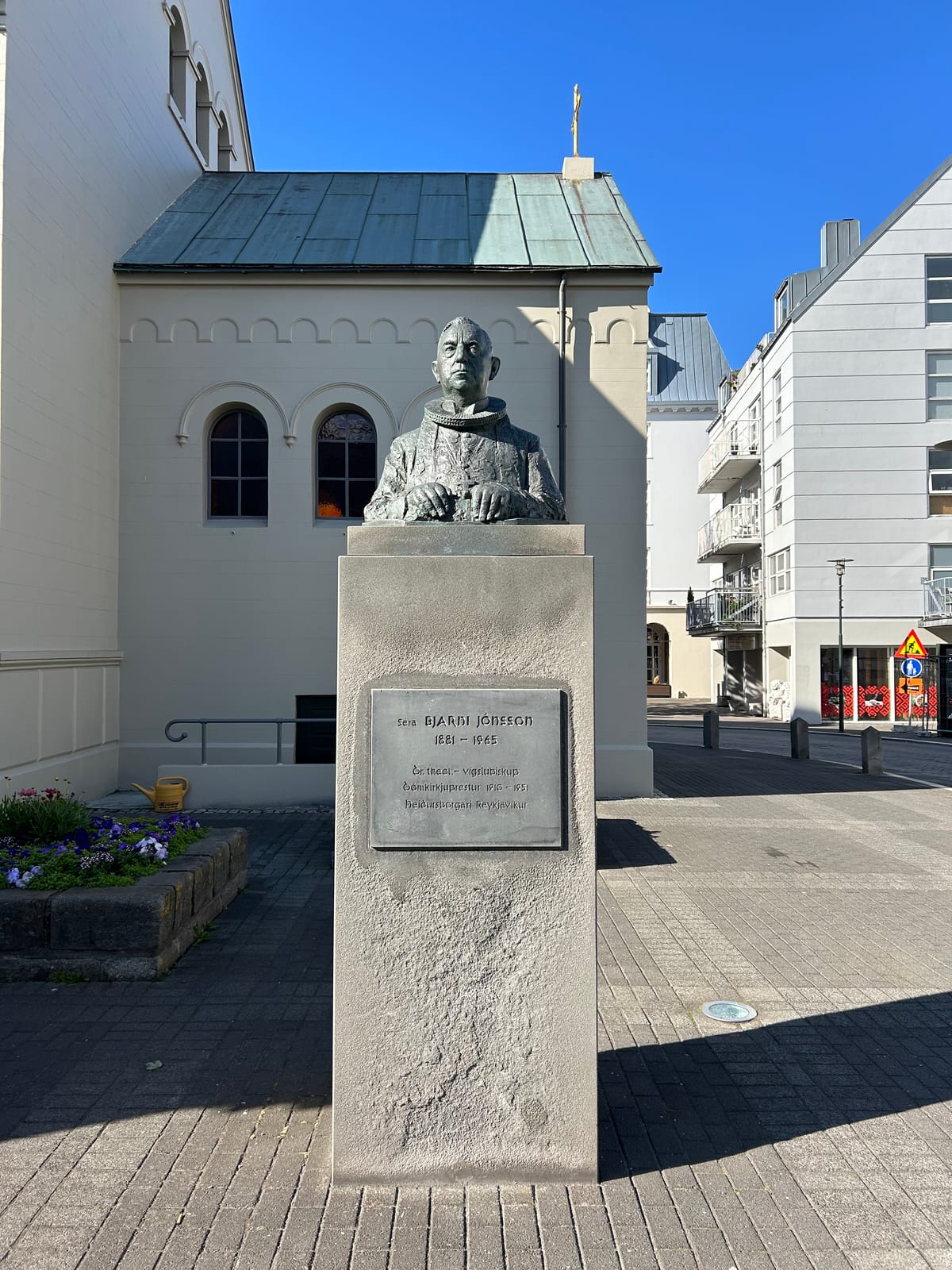
On the other side of Dómkirkjan from the bishop in his ruff stands a second bronze churchman, this one in the plain cassock and collar of a working priest. The stone under him keeps his record like a headstone keeps a name: séra Bjarni Jónsson, 1881 to 1965, priest of this cathedral from 1910 to 1951, honorary citizen of Reykjavík. Forty one years at one altar, in a town small enough that everyone passed it.
The dates understate him. Bjarni christened, confirmed, married and buried the town for four decades, which in a place the size of Reykjavík meant he ran the whole ceremonial life of the city more or less single handed. Generations went from the font to the altar to the graveside with the same voice presiding, and by the end of his run there was hardly a family in town without his signature somewhere in its story.
He was also, by every account, impossible to miss. He walked the same streets between home and church for decades, greeted and greeted back, and his dry one liners were passed around dinner tables the way other towns pass around weather reports. When Reykjavík made him an honorary citizen, an honour the city hands out about once a decade, it was less an award than a statement of fact.
The church made him a vígslubiskup, a consecrating bishop, and the university a doctor of theology, but the title that stuck was the smallest one: séra Bjarni, father Bjarni, no surname needed. There are men who hold offices and men who become them, and the plain bronze collar on the plinth says which kind he was.
The bust is the work of Sigurjón Ólafsson, the same hands that made Öndvegissúlur, the copper sculpture by Höfði, and it was set up beside the cathedral seven years after Bjarni’s death. Sigurjón had gone to the cathedral itself to model him, insisting on the real vestments in the real setting rather than a sitter in a studio chair, and the result reads true: not a monument to a dignitary, a portrait of a man at work.
Together with Jón Vídalín around the corner, he completes a pair of bookends on the church wall: the thunderer of Skálholt on one side, the neighbour from up the street on the other, two centuries of the Icelandic church in two bronze collars, ten steps apart.
The cathedral square is the easiest visit in the city, parliament on one side, the pond two minutes away, and the two churchmen watching the foot traffic the way they always did. Sign a photograph of séra Bjarni for the person who shows up for everyone, every time, the one whose presence is the ceremony, and the card says what Reykjavík spent forty years saying on the street: good to see you, séra.