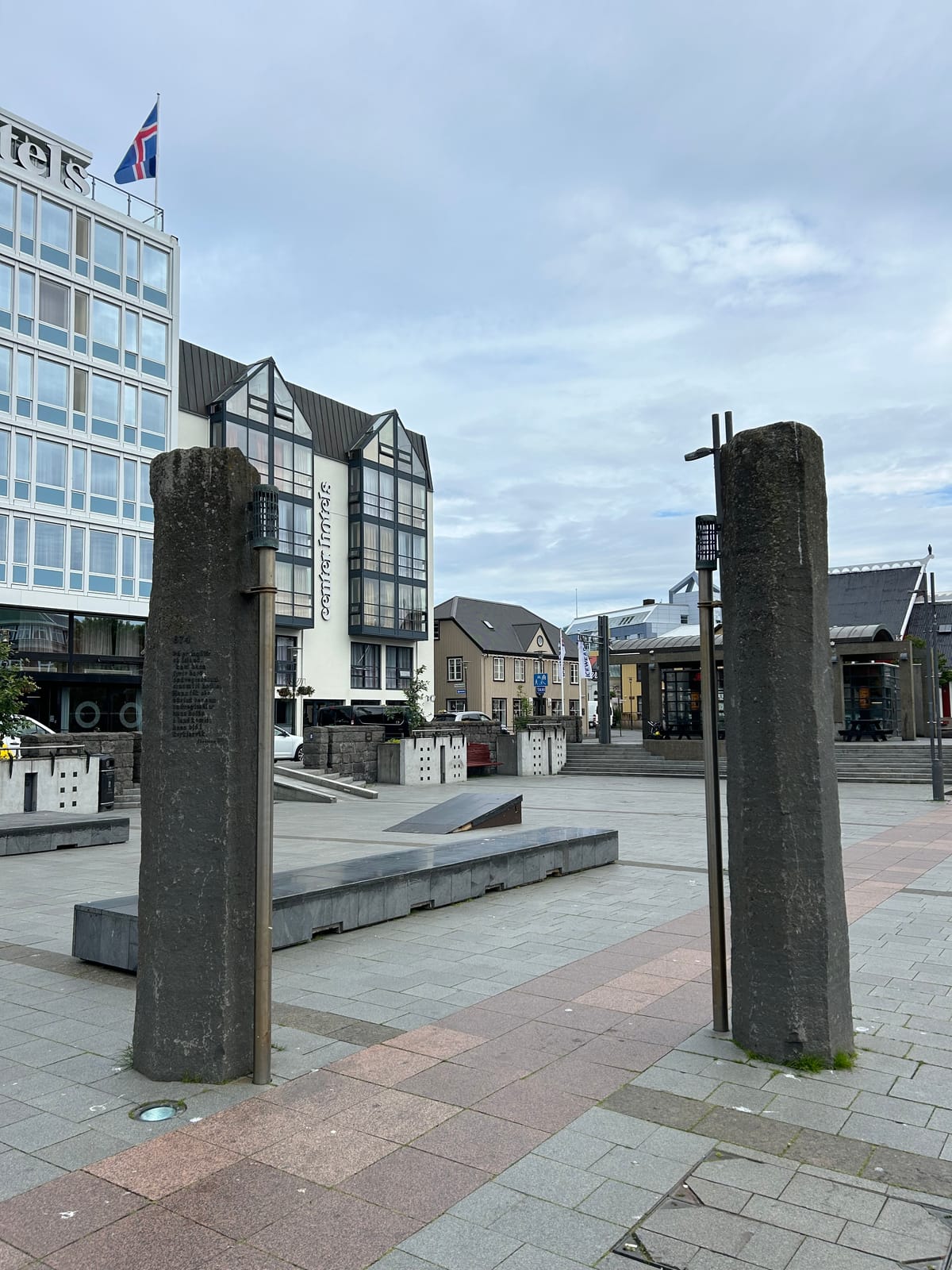
On a square in the old centre of Reykjavík, the kind ringed with café tables and tourist menus, there is a rough pillar of dark basalt that most people walk past on the way to lunch. Stand near it for a moment and you notice something the menus do not mention. Beside the stone, running parallel to it, a slim stainless steel pipe rises, and from it comes a thin plume of steam that does not stop, a low continuous breath of warm vapour. It is the single most literal monument in the city, and many people walk past it without knowing this is where the story of the city begins.
It marks the spot where the whole country is said to begin. This is one of two basalt pillars set here to mark the landfall of the öndvegissúlur, the high seat pillars of Ingólfur Arnarson, the chieftain the sagas name as the first permanent settler of Iceland. Everything else in Reykjavík is downstream of the story this stone is pointing at.
The story runs like this. Around the year 874 Ingólfur sailed from Norway toward a barely known island in the north, and as the coast came into view he did the thing his people did when they wanted the gods to choose for them. He threw the carved wooden pillars of his high seat overboard and swore to build his farm wherever the sea carried them ashore. Then he waited, and searched, and eventually the pillars were found washed up on a steaming shore, and there he settled with his household.
The inscription on the pillar puts it plainly, quoting the Book of Settlements: “Ingólfur saw Iceland, he threw his high-seat posts overboard for good luck. He declared that he would establish himself at the place where the beam came to land.” The shore they came to was full of steam rising off the hot ground, and Ingólfur named the place for it: Reykjavík, the bay of smokes. Which is the joke the monument is built around. The city named after its steam is marked by a monument that steams, its pipe fed by a geothermal vent so that a thousand years later the ground is still breathing exactly as it did on the day it was named.
It takes a little imagining to see what stood here then, because none of it is left. The settlers found a shore of low, slow growing birch forest, hot vents, a pond and a creek running down to the harbour. The sea itself came in much further than it does now, and whole city blocks have since been built out onto reclaimed land, so the old coastline ran along what is now Hafnarstræti, the harbour street that no longer touches the harbour. Turf walls from the settlement age have been dug up under the modern downtown, though no one can say whose houses they were, how many stood here, or what the first Reykjavík truly looked like.
This is not the only place the city tells the story. The tall bronze settler stands up on Arnarhóll with his spear. But this modest steaming monument on the restaurant square is the one that claims the actual coordinates, the X on the map, the here of it all, and it does so without a queue or a ticket or, until very recently, a marker on any map at all.
Which is worth one honest aside, since plainness is the house style here: as late as the summer of 2026 this monument to the exact spot the country began was somehow still not on Google Maps, so the person behind kyrrð, having walked past it three times and once watched a guide explain it to a tour group, checked the map in disbelief and added the pin themselves. The marker you navigate here by is, for once, ours.
Sign a photograph of it for someone standing at the very start of something, in the moment before they know where any of it will land. This is the spot where a whole country decided to begin, marked by a stone that has been steaming for eleven hundred years and shows no sign of stopping.