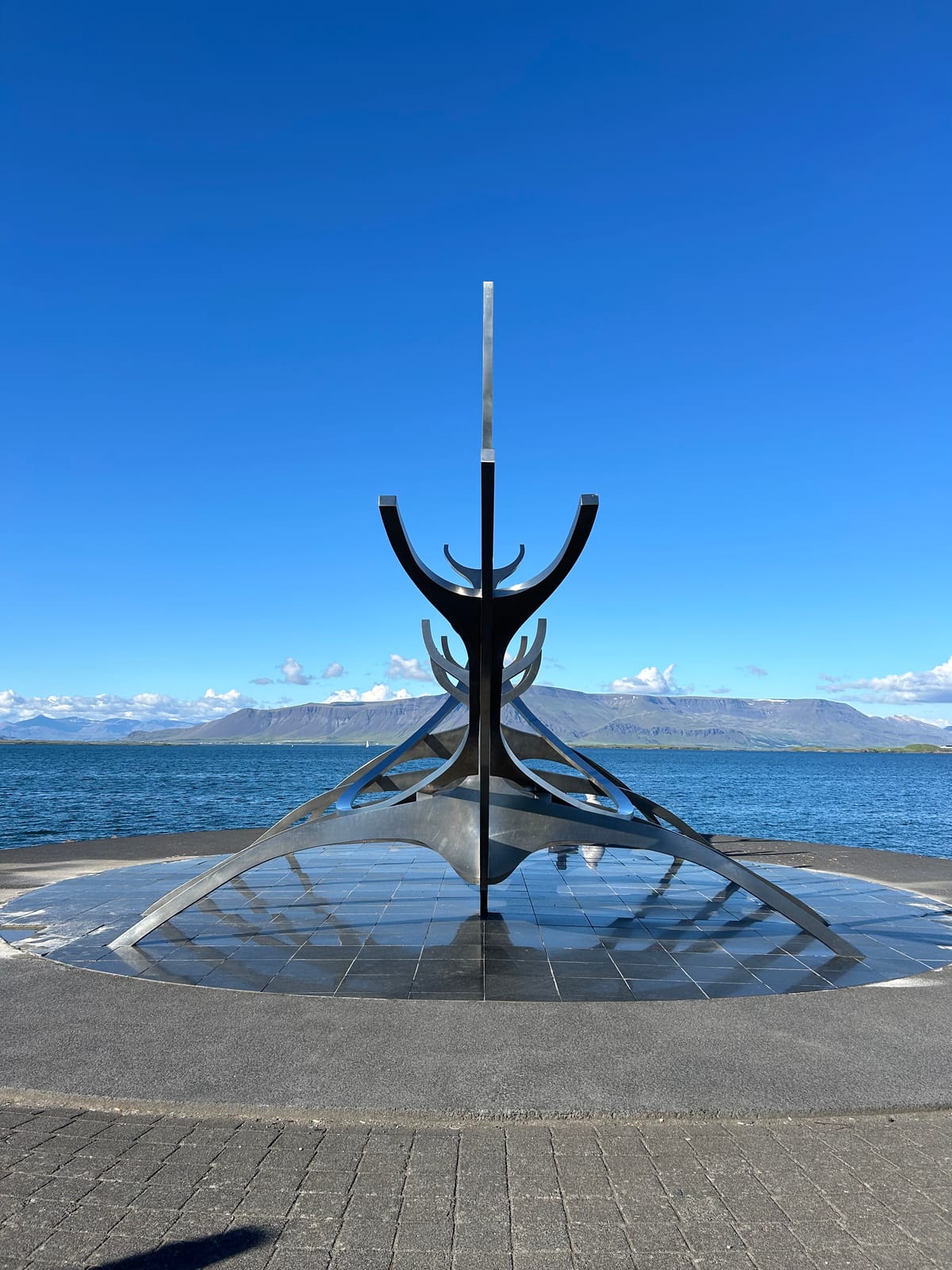
It sits on the edge of the Reykjavík waterfront, a polished steel frame in the shape of a boat, with ribs that curve up toward the sky and a prow that points across the bay at Mount Esja. People drift toward it all day, and by the end of the afternoon there is usually a small crowd standing around it, waiting for the light to do something. From a distance it looks like the clean skeleton of a ship that someone has set down carefully by the sea.
Almost everyone who meets it decides it is a Viking ship. It is easy to see why, with those swept lines and that hopeful prow, and the guides on the buses are not always in a hurry to correct anyone. The man who made it would have gently put them right. He thought of it as a dream boat, a vessel of light, an ode to the sun and to the idea of sailing toward country you have not seen yet. The Icelandic name, Sólfar, means something close to the sun voyager, and the work is about longing and the promise of somewhere new rather than about raiding a coastline.
Its maker was Jón Gunnar Árnason, a sculptor who spent his life interested in boats and in the sea and in the way metal can be made to feel weightless. He was already ill while he worked on it, and he died in 1989, before it was finished and set in place. The Sun Voyager was raised on the waterfront in 1990, so the city never got to show it to him standing where he meant it to stand. There is something fitting about a sculpture devoted to setting out that its own author never quite arrived to see.
The location does half the work. The sculpture faces north across the water at Esja, the long flat mountain that changes colour with every passing hour, and the steel takes whatever the sky is doing and hands it back to you. On a grey day it is cool and severe. In the low gold light of a summer evening it turns warm and almost liquid. The same object gives you a different photograph depending on when you stand in front of it, which is part of why people keep coming back to it.
It is an easy thing to visit. You walk east along the Sæbraut path from the old harbour and the Harpa concert hall, ten minutes or so with the sea on one side, and you will see it before you reach it. Sunset is the obvious time and it does get busy, but the crowd tends to thin if you wait a little, and there is room to stand apart and let the boat sit empty against the water. Bring a warm layer even in summer, because the wind comes straight off the bay.
A photograph of the Sun Voyager carries the same thing the sculpture does, which is the feeling of facing outward and wishing someone well on whatever they are heading toward. That makes it a natural thing to sign and send. You are handing a person a small steel boat pointed at the horizon, with a few of your own words attached, which is a gentle way to tell someone that you are thinking of where they are going.