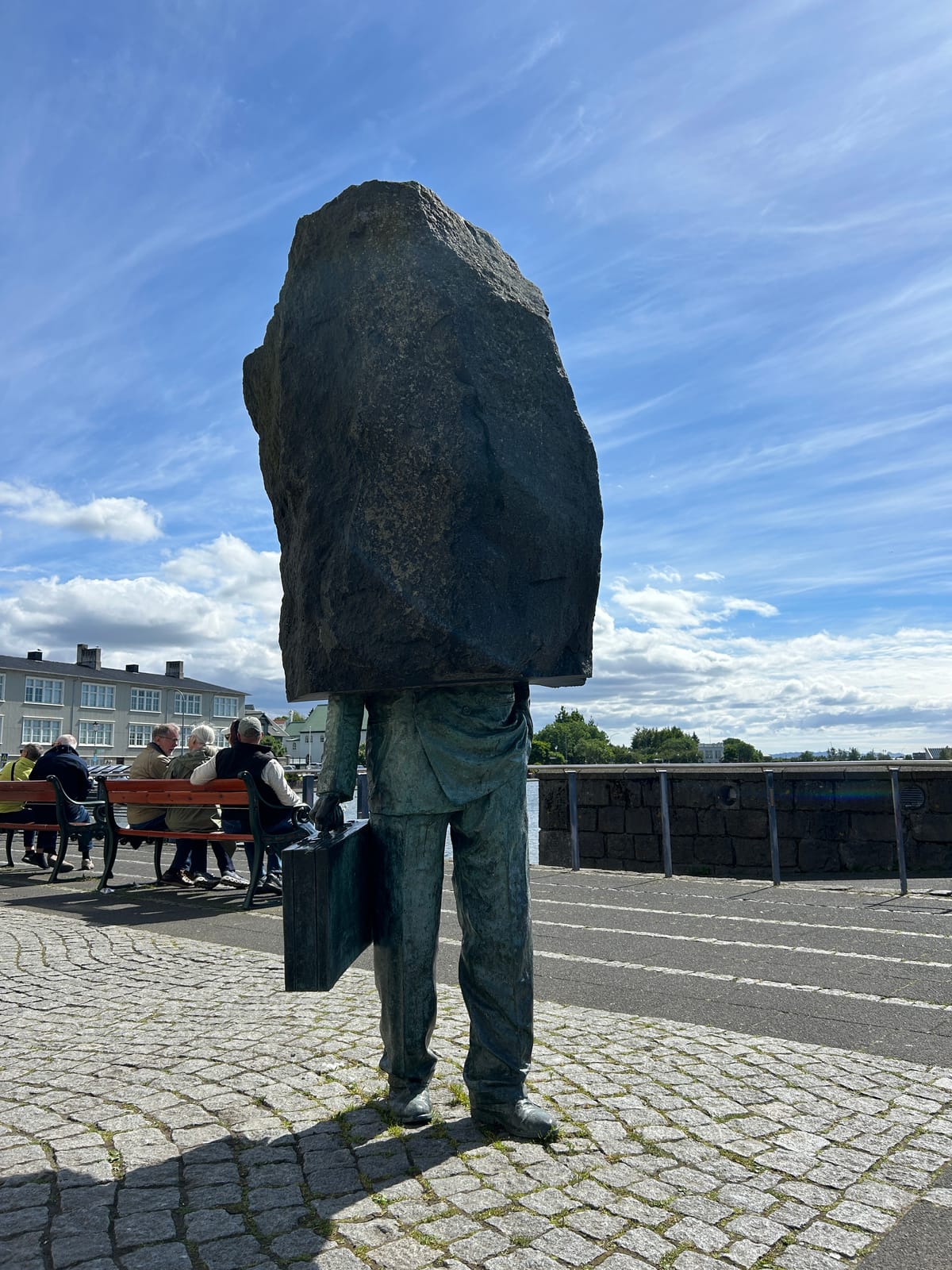
At the northern end of the city pond, where the long footbridge runs across to the City Hall, a man in a coat strides forward with a briefcase in his hand. Where his head and chest should be there is a rough, unworked block of Icelandic basalt. You can walk past him in a hurry and only register it a few steps later, and then you have to go back and look at him properly.
Most countries keep a monument to the unknown soldier. Iceland has never had an army, so it has no unknown soldier to mourn, and somewhere in that gap Magnús Tómasson found this idea and cast it in 1994. He called it the unknown bureaucrat, a tribute to the anonymous official who keeps a country running. Whether it is sincere or gently teasing is left entirely to you, and the honest answer is that it manages to be both at once.
The whole thing lives in the contrast. From the waist down he is precise and human, the creased trousers, the briefcase, the forward lean of a man with somewhere to be. From the waist up he is a slab of raw rock, faceless and heavy, the role sitting square on the shoulders of the person. It says more about work, and about being a small part of a large machine, than a page of writing could.
He is easy to find and easy to miss, which suits him. Look for him at the City Hall end of Tjörnin, by the water, among the ducks and the reflections of the houses around the pond. A slow loop of the pond takes you right past, and most of the people walking it never notice the joke standing at the edge.
There are few better things to send to a friend who is buried under a desk than a faceless office worker carved in bronze, signed with a kind word from you. It lands as a joke and stays as something a little warmer, which is about the most a card can hope to do.