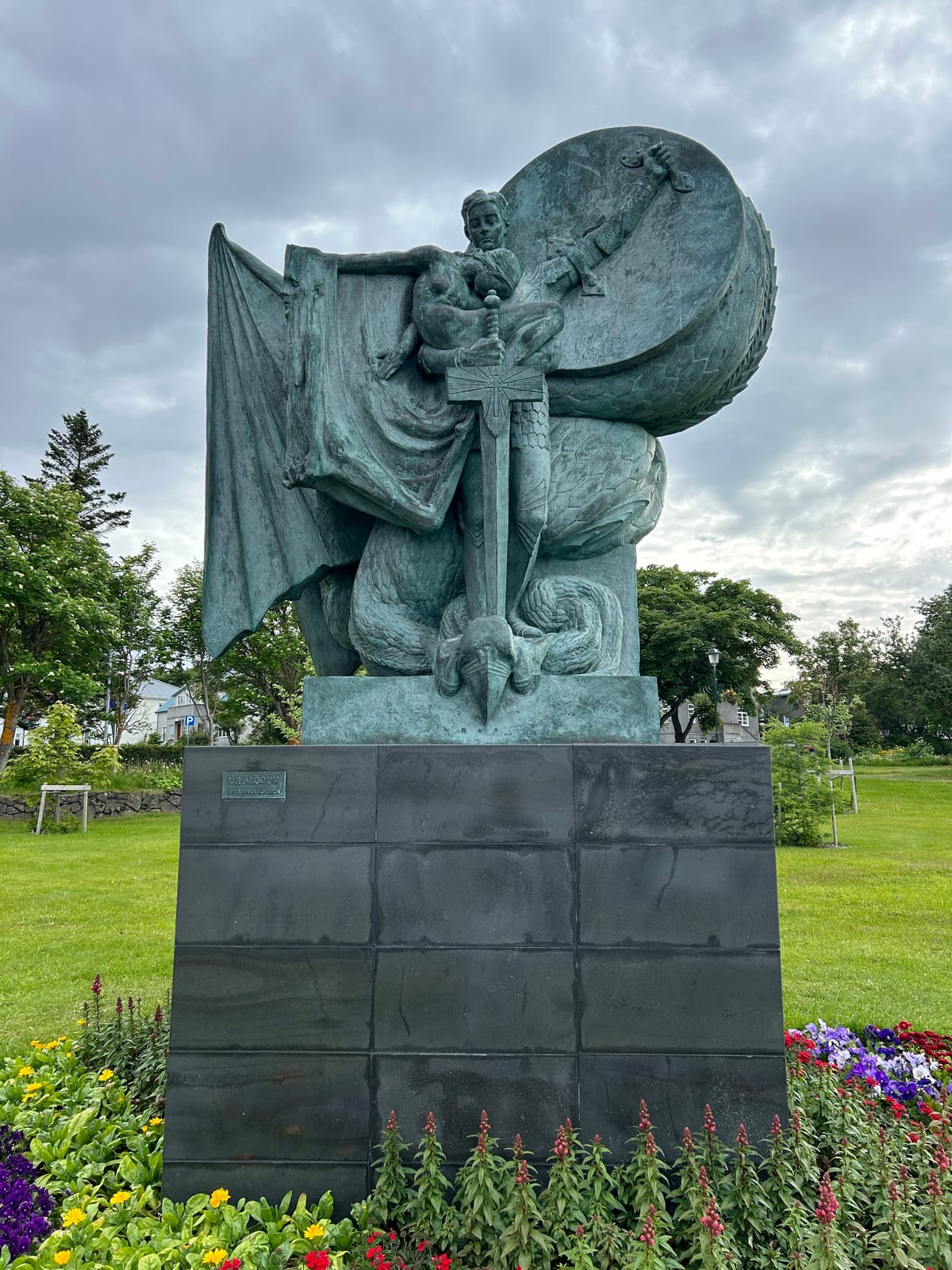
On the hill at Skólavörðuholt, in the shadow of Hallgrímskirkja, there is a house of pale stone that looks a little like a small fortress, and behind it a walled garden full of bronze. One figure in that garden stops most people who wander in. A powerful man stands with a great sword held point down before him, a beaten shape slumped at his feet and a smaller freed figure gathered against his side. The work is called Úr álögum, which means out of the spell, and it is about the moment a curse finally breaks.
The house and everything in the garden belong to Einar Jónsson, the first professional sculptor Iceland ever produced. He worked in a heavy, symbolic, dreamlike manner that has little to do with the plain daylight realism of most public statues, and his subjects are angels and heroes and souls hauling themselves out of matter. Úr álögum is one of the clearest of them. A young hero has overcome the thing that held someone under a spell, and the piece stands for the spirit breaking free of whatever binds it, told in the shape of an old fairy tale.
Einar lived from 1874 to 1954, and he made a bargain with his country that shaped the rest of his life. He offered the whole body of his work to the Icelandic nation on a single condition, that a home be built to keep it in, and the fortress like building his statue stands behind was raised to hold it. He called it Hnitbjörg, after the cliffs in the old myth where the mead of poetry lay hidden. It opened in 1923 as the first art museum in the country, and Einar lived and worked upstairs in it until he died. He gave everything away and then lived on top of it.
The bronzes in the garden are casts of his works, set out on granite among the grass and the flowerbeds, and the garden is open and free the whole year round. It is one of the strangest corners in central Reykjavík, a crowd of angels and riders and struggling figures standing in the open air a step away from the busiest church in the country, and hardly anyone in the queue for the church tower thinks to walk around the back and find them.
It rewards a slow circle. Einar meant his figures to be read rather than simply looked at, each one a small allegory of birth or grief or release worked out in bronze, and Úr álögum is the one most people carry away, partly because the story in it is so plain. There is a hero, a monster, a spell, and the moment it lifts. You do not need the label on the plinth to feel what it is about.
You reach it the easy way, by climbing up to Hallgrímskirkja and simply carrying on past it to the far side. The garden asks nothing of you, no ticket and no turnstile, and the museum indoors is there if you want the rest of the story. Come on an overcast day, which Reykjavík supplies without much effort, and the flat grey light suits the green bronze and the heavy themes far better than sunshine ever could.
Úr álögum is a good thing to send to a person climbing out of a hard stretch, a bad year or a long spell of something they are ready to be finished with. Sign the photograph with a steady word, and the picture tells them that the spell is breaking and the worst of it is behind them.