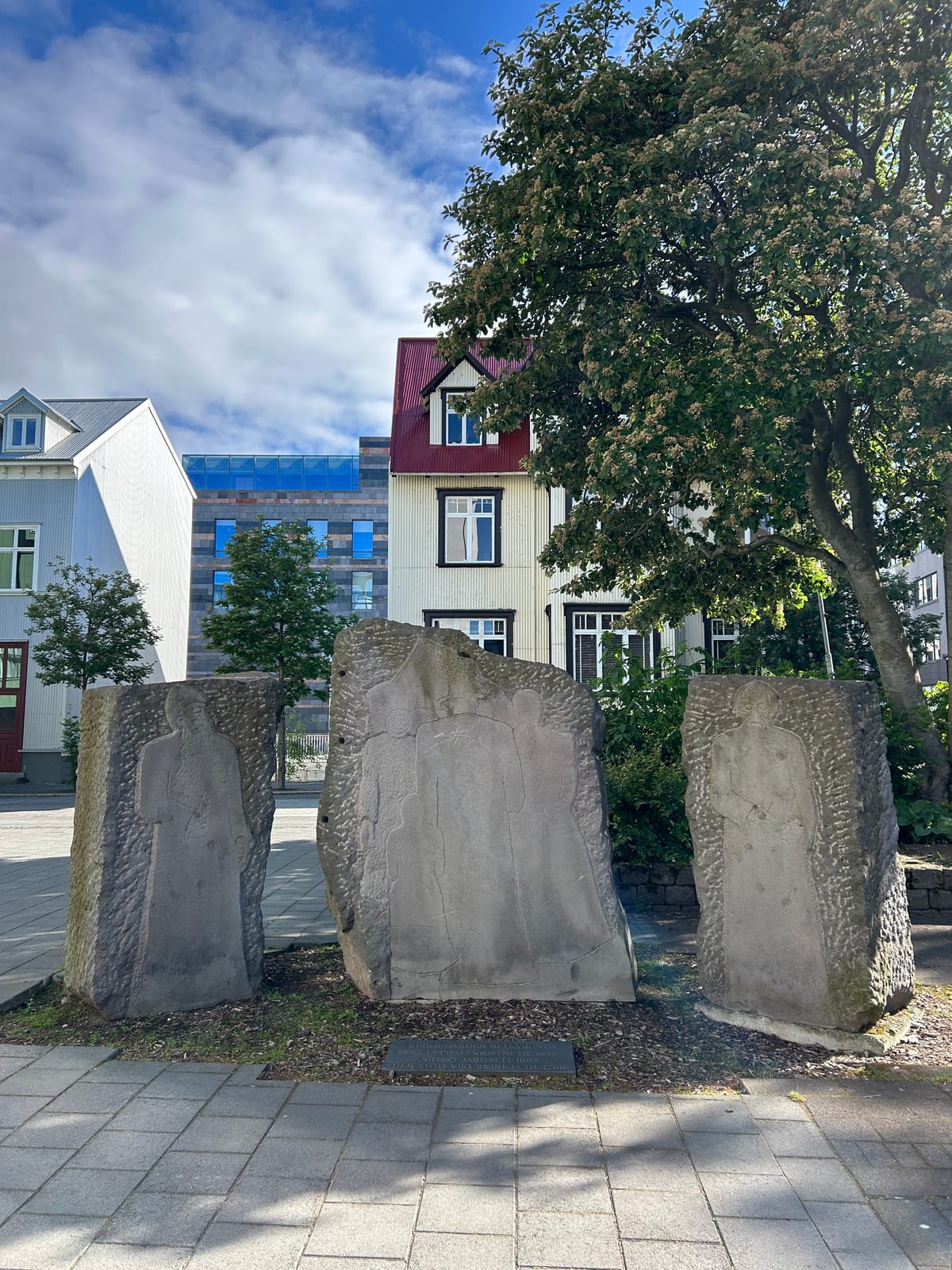
At the corner of a small park off Aðalstræti, where the oldest street in Reykjavík meets the coffee crowds, three rough grey stones stand upright in the grass. Walk past and they read as landscaping. Stop, and the sawn faces resolve into people: faint carved outlines of figures in old dress, half there and half gone, like photographs left too long in the light. They are meant to read that way. You are standing at the edge of a churchyard.
This is Víkurgarður, the burial ground of the original Reykjavík church, and it is the oldest marked ground in the city. A church stood here from around 1200, and by some accounts the burials reach back further, toward the settlement itself. The last church on the spot was taken down in 1789, when the new cathedral went up by Austurvöllur, but the yard kept receiving the town’s dead until 1838. Six centuries of Reykjavík lie under this one small lawn, farmers and fishermen, mothers and magistrates, in ground the city now walks over on its way to lunch.
The stones are the town remembering. The memorial was presented to the city on the sixteenth of June 2000 by the Bishop of Iceland, Karl Sigurbjörnsson, three grey standing stones, their backs left natural, their faces cut smooth and carved with the shallow figures of the parish, the congregation that vanished into this ground. There are no names. After six hundred years, names would have been a lie. What is left is the shape of people, which is what the ground actually holds.
The yard itself has had an unusual afterlife. In 1883 the country’s chief physician, Georg Schierbeck, got leave to plant a garden over the disused cemetery, and it became one of the first ornamental gardens in Iceland, which is why old trees stand here in a city that barely has any. Later the plot was named Fógetagarðurinn, the magistrate’s garden, and the bronze of Skúli Magnússon, the father of the town, was raised among the graves of the people he governed.
The city has pressed close around it. New buildings have gone up along its edges over the years, hotels among them, and the arguments about how near is too near have filled the papers more than once. The stones answer the question without raising their voice: this is not empty ground, and it never was.
It is the best kind of stop on a walk through the old centre, thirty seconds from Aðalstræti 10 and the Settlement Exhibition, with Skúli holding his corner of the same green. Almost nobody who crosses the park knows what the three stones are. Now you do, which changes the walk a little, the way knowing always does.
Sign a photograph of it for someone carrying a loss, or for the friend who keeps the family’s memory, the one who knows the names three generations back, and the card says what the stones say in their worn faces: the people before us are not gone, they are the ground we stand on.