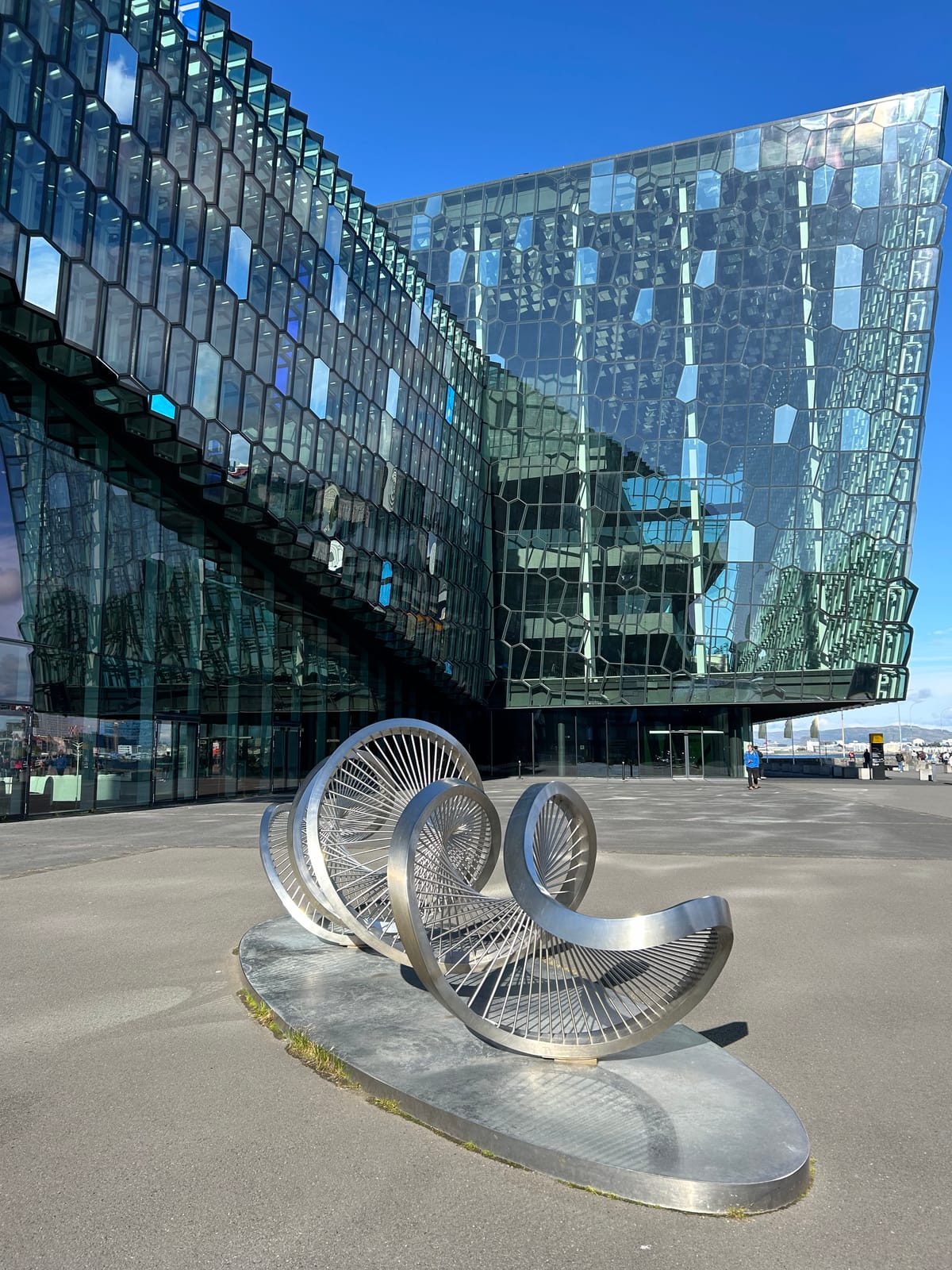
On the square in front of Harpa, where the concert hall’s glass wall catches the harbour light, a bright steel form curls out of the pavement like a wave caught mid turn. Strings run through the curl, dozens of them, tensioned between the sweeping edges. There is no plaque telling you to listen, and on a windy day none is needed. The sculpture hums. It is a harp, and the wind is the one playing it.
The idea is ancient. An aeolian harp, named for the Greek keeper of the winds, is an instrument built to be played by moving air alone, and people have been setting them in windows and on rooftops for centuries to hear the weather sing. This one is built of marine grade stainless steel on the scale of a small boat, tuned for a harbour that has never once run out of wind.
The name on the work is Himinglæva. In Norse mythology the sea giant Ægir and his wife Rán had nine daughters, each one a kind of wave, and Himinglæva is the small transparent wave that lets the light of the sky shine through. Sailors who felt the water move under their boats imagined her at work beneath them. It is a fitting patron for a sculpture that turns moving air into sound and moving light into shape.
The shape itself is drawn from physics. Elín Hansdóttir, the artist, based the form on a Lissajous figure, the looping pattern a beam of light traces when it is reflected off vibrating tuning forks. Which means the curl on the square is not a picture of a wave at all. It is a picture of a sound, cast in steel, set where the wind can play the real thing through it.
The sculpture waited a long time for its spot. Elín won the open competition for art around the future concert hall back in 2008, before Harpa was even finished, and the piece finally arrived on the square in 2022, a gift from the state and the city for the hall’s tenth birthday. A building named after a harp spent its first decade without one, and then got its instrument.
It rewards a slow visit more than a photo stop. Walk around it and the strings realign themselves against the glass wall behind, the loops open and close, and on a properly blustery day you can stand close and hear the overtones shift as the gusts change. Harpa’s honeycomb facade does the same trick with light that Himinglæva does with air, which is why the pair look like they were always meant to share the square.
It stands on the harbour side of Harpa, free and open at every hour, two minutes from the old harbour and five from the Sun Voyager. Sign a photograph of it for a musician, or for anyone who keeps making something good out of rough weather, and the card says what the harp proves every day: the wind is only noise until something is built to catch it.